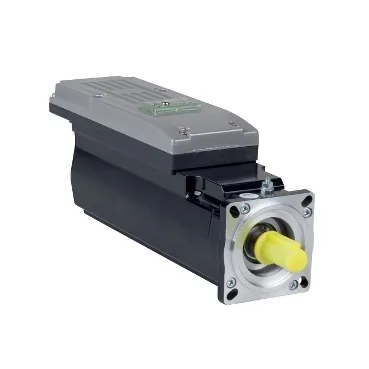
PacDrive 3 integrated servo motor — what the ILM0702P01F0000 actually delivers
The Schneider Electric ILM0702P01F0000 is a servo motor with integrated drive from the PacDrive 3 range, with the ILM device short name and a 70 mm motor flange. It packages the amplifier and the motor in one mechanical unit, which removes the separate drive cabinet slot and the feedback cable run that a conventional servo pairing needs. Continuous output is 720 W at a nominal speed of 6000 rpm, with 1.15 N.m of nominal torque. The torque constant of 0.76 N.m/A at 120 C winding temperature sets the current demand per N.m of load torque — that figure, not the headline power, is what the drive sizing calculation actually consumes.
Stall envelope, peak torque, and what they mean for the duty cycle
Continuous stall torque is 1.7 N.m at a continuous stall current of 2.5 A, so any start-stop profile that holds torque near zero speed must stay under that envelope. Peak stall torque reaches 7.6 N.m with a maximum Irms of 11.8 A — roughly six times the nominal torque — which defines the acceleration headroom available for short moves before thermal limits close in. Back EMF is 48 V/krpm at 20 C, so the motor generates a rising counter-voltage as it speeds up. Stator resistance drops from 4.2 Ohm Ph/Ph at 20 C to 2.92 Ohm Ph/N at 120 C, and stator inductance shifts from 19 mH Ph/Ph at 20 C to 9.5 mH Ph/N at 120 C — the cold-to-hot swing that the controller's current loop has to track without losing stability.
Feedback, brake, cooling — the parts the controls engineer has to plan around
Position feedback is an absolute single-turn SinCos Hiperface device, so the controller reads absolute shaft position on power-up with no homing move. An integrated holding brake delivers 3 N.m of holding torque, giving a fail-safe stop when the servo enable is removed. Cooling is natural convection — no fan, no blower duct, but also no margin for mounting the motor in a fully enclosed pocket with stagnant air. Shaft loading is the constraint most datasheet pages bury: radial force Fr derates from 710 N at 1000 rpm to 390 N at 6000 rpm, with axial force Fa limited to 0.2 x Fr. A belt drive or a gearbox on the shaft end has to be checked against the speed-corrected Fr figure, not the static one — that is where most overhung-load failures originate on this class of motor.
Mechanical envelope and panel-side fit
The ILM0702P01F0000 mounts on an international standard flange with a 70 mm flange size, 252 mm body length, an 18 mm key width, an 11 mm shaft diameter and a 23 mm shaft length. Four 5.5 mm mounting holes and a 60 mm centring collar set the bolt pattern. IP54 means the body resists dust and splashing water, but it is not a washdown-rated enclosure — washdown lines need a higher IP on this package or a protective shroud.