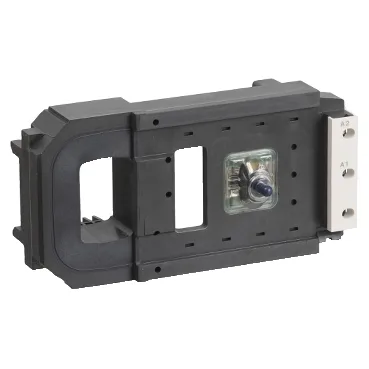
Coil swap constraints for the LX9FL912
The LX9FL912 is a specific contactor coil in the TeSys F range, rated for 48 V AC/DC control. It pulls 733 W inrush at 20 °C and settles to 48 W hold-in, so the control transformer needs headroom for that inrush spike — don't share the same 48 V supply with sensitive PLC outputs without a separate contactor driver. Opening takes 60 ms, closing 20 ms. That asymmetry matters if you're sequencing contactors for motor reversal or bypass — the slower dropout means you need a longer dead time between open and close commands to avoid a phase-to-phase short. No built-in suppressor module on this coil. You'll need an external RC snubber (for AC) or a free-wheeling diode (for DC) across the coil terminals, or the back-EMF will take out the PLC output card or relay driving it. The coil inductance is 0.2 H when closed, which stores enough energy to arc a relay contact on dropout.
Panel thermal and mounting notes
Heat dissipation runs 22.8 to 27.8 W depending on control voltage and temperature. That's not trivial — in a dense TeSys F starter stack, you need to account for this in the enclosure thermal calculation. At 1800 cycles/hour maximum at 70 °C, the coil is rated for sustained high-duty applications like conveyor start-stop sequences. The dropout voltage window is 0.3 to 0.5 Uc at 55 °C, meaning the coil will reliably drop out between 14.4 and 24 V on a 48 V system — no risk of the contactor chattering on a sagging control bus. Mechanical durability is rated at 5 million cycles. That's the coil itself — the contactor's electrical life will be lower under load, but the coil won't be the wear-out item in most applications.