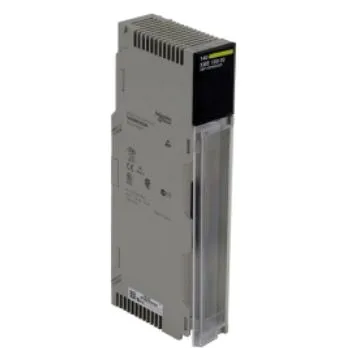
Intrinsically safe discrete output for Quantum in hazardous areas
The Schneider Electric 140DIO33000 is an intrinsically safe discrete output module for the Modicon Quantum automation platform. It provides eight open-collector outputs at 24 V, with a total module capacity of 360 mA and 45 mA per point. The module carries the marking CE II1 G/D-EEx ia IIC, confirming its suitability for use in conjunction with products for zone 20, 21, or 22 hazardous dust environments, per the specification.
The 360 mA module limit is the aggregate current across all eight points; the 45 mA per-point ceiling governs individual channel loading. Off-state leakage is specified at 0.4 mA per point, which is relevant when driving sensitive loads that must see a clean off-state. The response time is 1 ms for both state transitions (resistive load), so the module is suited for discrete on/off control rather than high-speed pulse trains. Isolation between channels and the backplane bus is rated at 2500 V DC for 1 minute (1780 V AC at 47–63 Hz), providing robust galvanic separation for the intrinsically safe barrier. The module dissipates 5 W and draws 2.2 A from the Quantum backplane; this bus current draw must be factored into the rack power budget. Operating ambient temperature range is 32 to 140 °F (0 to 60 °C), with storage from -40 to 185 °F (-40 to 85 °C). Maximum operating altitude is 5000 m. Relative humidity tolerance is 95% without condensation. Per the specification, hot swapping is not allowed due to intrinsic safety standards.
The module is fully compliant with ATEX Directive 94/9/EC, EN 50281-1-1, EN 50284, EN 50039, EN 50014, EN 50020, CSA C22.2 No 142, and UL 508. EMC immunity is specified at 9.1 V/m (10 V/m) over 80–2000 MHz per IEC 801-3, and ESD withstand is 4 kV contact / 8 kV air per IEC 801-2. Transient voltage suppression and an internal fuse provide on-board protection.
Software and configuration
The 140DIO33000 is supported under Concept V2.2 and above, ProWORX, and Unity Pro. This covers the major Quantum programming environments, so no software migration is required for existing Quantum sites.