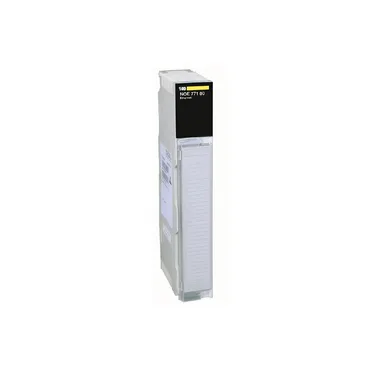
What the 140NOC77100 does in a Quantum rack
The 140NOC77100 is a Modicon Quantum Ethernet/IP network module that provides a single RJ45 10BASE-T/100BASE-TX port for connecting the local rack to an EtherNet/IP control network. It handles both implicit I/O messaging and explicit CIP messaging, plus SNMP agent and DHCP/BootP server services — enough protocol depth to integrate a Quantum controller into a modern line without a separate gateway card. It draws 500 mA from the 5 V DC backplane supply of the rack, so the rack power budget must have that headroom per slot. The module supports up to 128 connections, which sets the ceiling for how many remote I/O adapters or peer controllers can maintain simultaneous cyclic data exchange.
Lifecycle status — obsolete, sourced through surplus channels
Schneider Electric lists the 140NOC77100 as obsolete. No official successor part number is published for this Ethernet/IP module. Units are available through independent surplus and broker channels; each lot is confirmed at quote time, and quantities are typically limited to what remains in the distribution pipeline.
Compliance and approvals for the control panel
The module carries CE marking and is listed under UL 508 and CSA C22.2 No 142, plus FM Class 1 Division 2 approval for hazardous locations — so it can be installed in a panel serving a classified area provided the enclosure and wiring methods also meet the Division 2 requirements.
Diagnostic LEDs and fieldbus integration
Nine front-panel LEDs give the commissioning engineer a direct read on module status, network status, link integrity, duplex/collision, and transmit/receive activity on the bus. The green/red bicolor for Mod Status and Net Status follows the standard EtherNet/IP device profile — a solid green on both means the module is online and the I/O connection is established, which is the first thing to check when the controller won't talk to remote adapters. The module format is standard for a Quantum slot, and it is not a standalone redundant unit — it relies on the rack's own power supply and backplane, with no onboard redundancy logic. For high-availability architectures, a pair of these modules would require a separate redundancy scheme at the controller level.