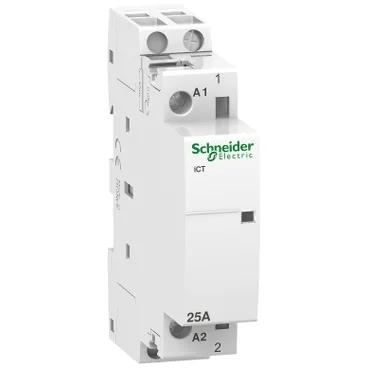
The Schneider Electric A9C20431 is a single-pole (1P) contactor from the Acti9 iCT range, designed for residential and small-commercial panelboards. It clips onto a 35 mm symmetrical DIN rail and occupies two 9 mm module pitches (18 mm wide). The contactor provides one normally-open (1 NO) power pole, rated for 25 A in AC-7a duty (general resistive and inductive loads) and 8.5 A in AC-7b duty (motor loads). Coil is 127 V AC at 60 Hz, maintained control signal type. The 25 A AC-7a rating covers lighting, heating, and general resistive loads up to that current. The 1 NO pole means it closes one line path only; no auxiliary contact is integrated in the base unit.
Rated operational voltage is 250 V AC at 60 Hz, so this is a single-phase line-voltage contactor — not for three-phase motor circuits or DC switching. Insulation voltage is 500 V AC, giving headroom for transient overvoltages on a 250 V system. Electrical durability varies by duty cycle: 100,000 cycles at 25 A AC-7a, 30,000 cycles at 8.5 A AC-7b, and 30,000 cycles under AC-3 motor switching. Mechanical durability is 1,000,000 cycles, so in lightly loaded or resistive applications the contacts will outlast the mechanical life. Switching frequency is capped at 100 operations per day — fine for lighting contactors or occasional motor start/stop, not for high-cycle automation. Inrush power is 15 VA; steady-state holding power is 1.3 W at 250 V AC. The coil draws a brief surge on pickup but settles to a low holding current — important when the control transformer or PLC output is sized near its limit.
The 18 mm width (2 module pitches) matches standard Acti9 modular enclosure spacing. Depth is 68.5 mm, height 81 mm — fits within a standard 100 mm deep distribution board. IP20 finger-safe terminals; IP40 when installed in a modular enclosure. Terminal blocks accept up to 6 mm² rigid or 4 mm² flexible on the power side, 2.5 mm² on the control side. Tightening torque is 0.8 N·m for both power and control circuits.