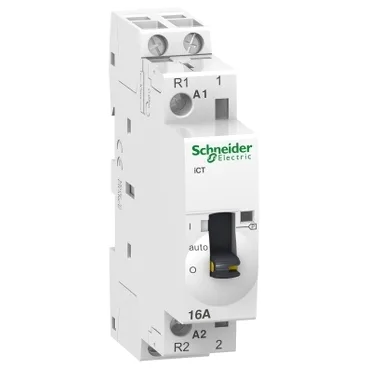
Rated operational current is 16 A in AC-7A duty (general-use inductive loads like small motors) and 6 A in AC-7B (resistive loads like heating). The 220 VAC 50 Hz coil is maintained-signal type, meaning it stays closed as long as control voltage is applied. Built to IEC/EN 61095, the standard for household and similar electromechanical contactors. Pollution degree 2 rating suits it for normal factory or residential environments where only non-conductive dust accumulates.
The 6 A AC-7B rating covers resistive loads like heaters or incandescent lighting. Don't swap these duty classes: AC-7A has higher inrush, so using it on a resistive load is fine, but using the AC-7B rating for a motor will shorten contact life. Electrical durability is specified per duty: 100,000 cycles at 16 A AC-7A, 30,000 cycles at 6 A AC-7B, and 100,000 cycles in AC-1 (resistive). Mechanical durability is 1,000,000 cycles, so the contacts — not the mechanism — are the wear item. Switching frequency is rated at 100 operations per day, which is typical for lighting or HVAC zone control. The 2-pole configuration uses 1 NO + 1 NC contact set. The NO pole switches the load; the NC pole can be used for a status feedback or auxiliary interlock. Control circuit terminals accept up to 2.5 mm² flexible wire; power terminals accept up to 6 mm² rigid.
Physical integration and environment
Width is 18 mm (1 module width), height 81 mm, depth 68.5 mm. IP20 finger-safe terminals, IP40 behind the panelboard cover. Tropicalisation treatment per EN 60947-4-1 and EN 61095 protects against humidity and fungus in warm climates. Noise level is listed at 30 dB — the coil hum is low enough for residential or office-adjacent panels. Inrush power draw is 15 VA; steady-state maximum power is 1.3 W at 250 VAC.
Compliance documentation covers IEC/EN 61095 as the primary standard.