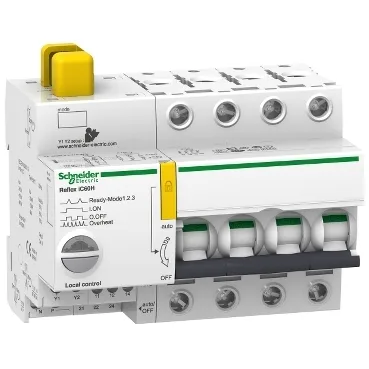
It combines overcurrent protection (thermal-magnetic trip, curve B) with local and remote switching capability in a single 4-pole unit rated 10 A. The 30 kA breaking capacity at 230 V AC (15 kA at 380–415 V) per EN/IEC 60947-2 tells you it can safely interrupt fault currents up to that level without upstream damage, which drives selectivity coordination in a distribution board.
The fixed mounting and 4-pole width (13 x 9 mm pitches, 117 mm wide) mean it occupies a defined slot in a distribution board; plan the DIN rail fill factor accordingly.
Control and signalling
Control options include a local ON/OFF button, remote pulse, remote continuous command, and toggle — all selectable via the control signal type (maintained very low voltage, maintained, or impulse). The control circuit accepts 230 V AC, 24 V AC, 48 V AC, 24 V DC, or 48 V DC, so it integrates with both AC and DC control systems. Local signalling uses a flashing LED for tripped, overheat, or device-ready status, plus a green LED for ON and a red LED for fault — useful for quick panel diagnostics without a meter. A contact position indicator and padlock provision (OFF position) support lockout/tagout procedures.