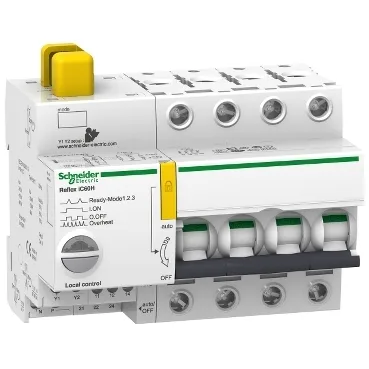
It's rated 10 A, 4 poles, curve C, and carries a 30 kA Icu breaking capacity at 220-240 V AC (15 kA at 380-415 V AC) per EN/IEC 60947-2. The thermal-magnetic trip unit handles the protection side; the control side accepts maintained or impulse commands at 230 V AC, 24 V AC, 48 V AC, 24 V DC, or 48 V DC.
For a panel with a prospective fault current under that threshold, this breaker clears the fault without needing an upstream fuse or larger breaker to protect it. The 15 kA rating at 380-415 V AC is the same figure for three-phase networks; if your line-to-line fault current exceeds that, you need to coordinate with a current-limiting device upstream. It avoids nuisance tripping from inrush currents that a curve B would catch, but trips faster on high faults than a curve D would. The neutral pole is protected (switched and monitored), not just a solid link. That matters for TN-S or TN-C-S systems where you need full isolation on all conductors during maintenance.
Fixed mounting mode, so it clips in place and stays put. The 117 mm width (13 x 9 mm pitches) and 84 mm height fit a standard modular device footprint; the 77 mm depth leaves room for wiring behind the DIN rail. The control interface supports three command types: remote control by pulse, remote control by continuous command, and local ON/OFF toggle. That flexibility lets you wire it to a PLC digital output for automated load shedding, or to a manual pushbutton for local override. The green/red/flashing LED signalling gives immediate visual feedback on device state, trip, and overheat conditions — useful during commissioning and fault finding.