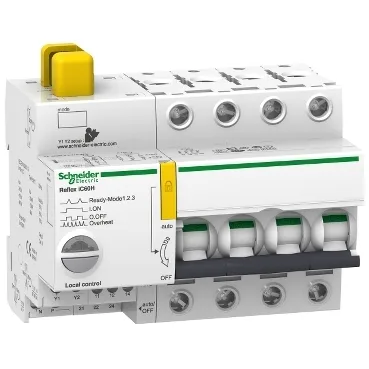
Breaking capacity is 30 kA Icu at 220–240 V AC and 15 kA Icu at 380–415 V AC, per EN/IEC 60947-2 — that's the fault current it can safely interrupt without welding contacts or venting plasma. For a 10 A device, that's serious headroom; it'll hold coordination downstream of a transformer or in a sub-distribution board where fault levels are high. Four poles protected (4P), so it breaks all lines simultaneously on a fault or remote command. The control circuit accepts 230 V AC, 24 V AC, 48 V AC, 24 V DC, or 48 V DC — common voltages for building management or PLC-driven panels.
Fixed mounting mode, so it stays put once clipped. Dimensions: 117 mm wide (that's 13 modules of 9 mm pitch), 84 mm tall, 77 mm deep. The width is the main panel-space consideration: at 13 pitch units, it's wider than a standard 4P MCB because of the integrated control electronics and the ON/OFF button with local signalling (green LED for ON, red for fault, flashing for trip or overheat). Padlockable in the OFF position — useful for lockout/tagout without needing a separate hasp. Earth-leakage protection is handled by a separate block (not built in), so if you need RCD functionality, you add an external Vigi module downstream.
What the durability ratings tell you
Mechanical endurance is 50,000 cycles; electrical endurance under AC-1 (resistive load) is also 50,000 cycles at 50 Hz. That's typical for a panel-mounted control breaker — not a daily-switch duty cycle, but fine for occasional remote operation or emergency stop reset. The tropicalisation class 2 means it's treated against humidity and fungal growth for use in warm, damp environments (up to 93% RH at 40 °C).