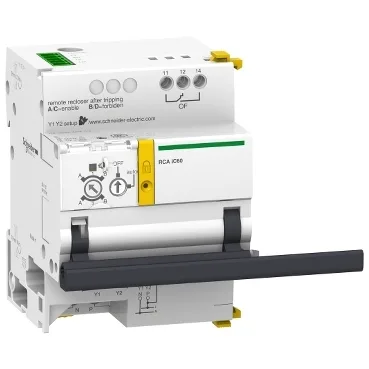
The Schneider Electric A9C70124 is an Acti9 RCA remote control auxiliary with a Ti24 interface, designed to mount alongside an iC60 3P or 4P circuit breaker. It provides remote control impulse and maintained switching of the breaker at 230 V AC 50/60 Hz, plus a maintained Ti24 24 V DC control option for low-voltage signalling systems. The unit draws 5 mA on the impulse and maintained AC inputs, and 5.5 mA on the maintained very-low-voltage input. Rated insulation voltage is 400 V with a 6 kV impulse withstand, pollution degree 3 per IEC 60947, so it's built for the dirty, transient-heavy environment of a commercial or industrial distribution board. The response time is under 500 ms, and the minimum impulse duration on the control circuit is 200 ms — short enough for PLC-driven commands but long enough to reject noise spikes. Power consumption sits at 1 W, and the unit is rated for 10,000 electrical and 10,000 mechanical cycles. That's a standard durability figure for a contactor-style auxiliary in this class — fine for lighting or HVAC cycling, but if you're switching a load every few seconds, you'll want to check the duty cycle against your application.
Snaps onto DIN rail, fixed mounting mode. The housing is 93 mm high, 63 mm wide, and 75.5 mm deep, spanning 7 pitches of 9 mm each. White colour, IP20 finger-safe, IP40 inside a modular enclosure per IEC 60529. Wire stripping lengths are specific: 10 mm for power supply and input (bottom connection), 8 mm for output (top connection), and 10 mm for the Ti24 interface terminal. Tightening torques run 0.7 N·m on the auxiliary output, 1 N·m on auxiliary supply and input. The unit is padlockable, and it is NOT compatible with comb busbars or distribution blocks — plan for individual ring-tongue or ferrule terminations. The Ti24 physical interface carries one volt-free OF contact rated 24…230 V AC, 0.01…1 A, plus one OF Ti24 and one SD Ti24 output at 24 V DC, 100 mA. That gives you both a dry contact for a PLC input and a low-voltage status signal for a bus coupler or indicator lamp. Local signalling uses a flashing green LED for ready-to-operate and a flashing orange LED for not operational.
Control modes and settings
The A9C70124 offers a selector switch with multiple operating modes: Auto (remote control authorized), Off (remote control inhibited), Mode 1 (central control), and Mode 3 (central control with local override). Additionally, Position A allows reclosing after tripping, while Position B inhibits reclosing after tripping. This flexibility lets a facilities engineer lock out remote commands during maintenance while still allowing local override for testing. Ambient operating temperature range is -25…60 °C, storage -40…70 °C, with 93 % relative humidity at 40 °C and tropicalisation class 2. Overvoltage category II means it's intended for the load side of a distribution board, not for direct mains connection. The unit is rated for use in pollution degree 3 environments — think dusty or conductive-contaminant conditions typical of industrial switchgear.