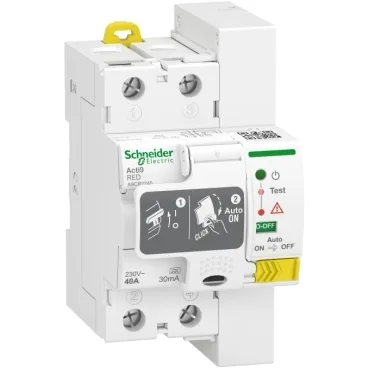
It combines earth-leakage protection (30 mA, Type A) with a programmable reclosing cycle, so it can automatically restore power after a transient insulation fault clears, without sending a technician to the panel. The reclosing logic is what sets this apart from a standard RCCB: after a fault trip, it waits 10 seconds, then attempts a reclose. If the fault persists, it stops after three attempts with a 180-second interval between closings. It monitors for insulation fault presence and will not restart the cycle if a permanent fault is detected.
The 40 A rated current (In) matches the typical main incomer or heavy-outgoer capacity in a domestic or small commercial DB. For pure DC or high-frequency residual currents, you would need Type B. The mechanical durability of 4000 open-close cycles is the expected life of the switching mechanism under no-load or low-load conditions. In a recloser application, each auto-reclose attempt consumes one cycle, so the service life depends on how often the downstream circuit faults. The 82 mm depth (106 mm height, 54 mm width) fits standard modular enclosure cutouts at 6 x 9 mm pitch modules.
The A9CR2240 is designed to EN 50557, the European standard for automatic reclosing devices (ARDs) for RCCBs. It carries 8/20 µs wave immunity to 250 A for electromagnetic compatibility, and its minimum leakage resistance is specified at 16 kΩ in operating condition and 8 kΩ non-operating.
The A9CR2240 is listed as current production — still an active catalogue item from Schneider Electric.