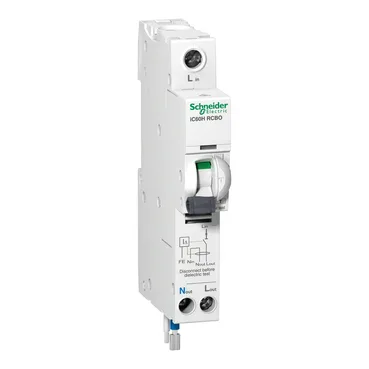
It protects a single-phase final subcircuit (1P + Ns, neutral left) against both overload/short-circuit and earth leakage. The 16 A rated current at 50 °C and 30 mA earth-leakage sensitivity cover standard socket-outlet and lighting circuits in commercial and residential distribution boards. The D-curve characteristic (10–20× In magnetic trip) is sized for loads with high inrush, such as small motors, transformers, or fluorescent lighting banks — the 250 A surge current rating confirms it holds through starting peaks without nuisance tripping. Breaking capacity is 10 kA Icn at 230/240 V AC, 50/60 Hz — sufficient for most TN earthing-system installations where the prospective fault current at the board does not exceed that level. The thermal-magnetic trip unit is self-powered; no auxiliary supply needed. The RCBO clips onto a standard DIN rail (35 mm) and occupies 2 × 9 mm pitches (18 mm wide), so it fits a standard 18 mm module position in a consumer unit or distribution panel.
Compliance documentation is standard for the Acti9 range: the RCBO carries approvals to BS EN 61009-1, IEC 61009-1, IEC 61009-2-2, and AS/NZS 61009.1. These cover the combined overcurrent and residual-current protection requirements for the listed markets. The IP20 degree of protection means it is suitable for installation inside a distribution enclosure, not in wet or dusty locations.
The 18 mm width (2 × 9 mm pitches) and 77.5 mm depth fit standard distribution board cutouts. The 45 mm grid distance aligns with busbar systems for the Acti9 range. Wire stripping length is 14 mm top, 13 mm bottom. The toggle control provides local ON/OFF indication and is padlockable with a Ø 4 mm padlock for lockout/tagout. Rated for 5000 electrical cycles and 20,000 mechanical cycles — the mechanical figure governs handling and isolation duty; the electrical figure governs switching under load.