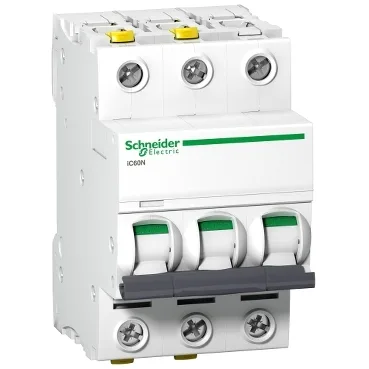
The A9F05350 is a Schneider Acti9 iC60N miniature circuit breaker rated at 50 A with a D tripping curve, meaning its magnetic trip threshold is 12× In ±20% — it holds through motor inrush and high-starting-current loads without nuisance tripping, then clears fast on a hard fault. The 3-pole (3P) configuration handles three-phase distribution circuits in a DIN-rail panel, with a 54 mm width (6 x 9 mm pitches) that fits standard enclosure layouts. Breaking capacity is the real selector here: 36 kA Icu at 12-133 V AC, 20 kA at 220-240 V, 10 kA at 380-415 V, and 6 kA at 440 V AC, all per EN/IEC 60947-2. It also carries a 10 kA Icn at 400 V per EN/IEC 60898-1. Dual-certified to both EN/IEC 60947-2 (industrial) and EN/IEC 60898-1 (residential/commercial), the iC60N is suitable for isolation per both standards. The thermal-magnetic trip unit gives you the familiar bimetal overload curve plus a magnetic short-circuit response, with a separate earth-leakage block available if you need it.
D curve — why it matters for motor and transformer circuits
A D-curve MCB like this one trips magnetically at 12× In (600 A for the 50 A frame), compared to 5-10× In for a C curve or 2-3× In for a B curve. That wider magnetic hold lets it ride through the inrush of a 50 A-rated motor, transformer, or discharge lamp bank without nuisance opening, while still providing short-circuit protection. If your load is resistive or general-purpose, a C curve would trip faster on lower faults — but for inductive starting loads, the D curve is the right call.
Snap-on DIN rail mounting (per EN/IEC 60715) — 54 mm width occupies 6 module positions. Double terminal top and bottom accepts 1-35 mm² rigid or 1-25 mm² flexible, with a 3.5 N·m tightening torque and 14 mm strip length.