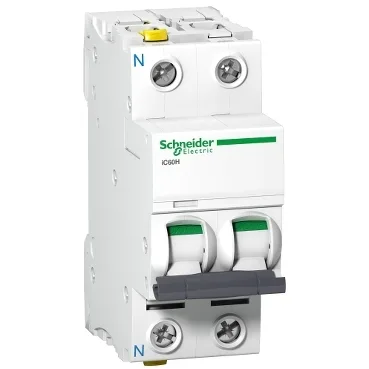
The Schneider Electric A9F06620 is a 20 A B-curve miniature circuit breaker from the Acti9 iC60H series, configured as 1P+N — one protected pole plus a switched neutral. The B-curve magnetic trip operates at 4 x In (±20 %), so it trips between 80 A and 96 A on short-circuit — fast enough to protect 2.5 mm² copper wiring in lighting and socket circuits, but avoids nuisance tripping on modest inrush from small motors or capacitive loads.
Breaking capacity and dual standard certification
The ultimate breaking capacity (Icu) under 60947-2 reaches 42 kA at 12-60 V AC, 30 kA at 100-133 V AC, and 15 kA at 220-240 V AC. Under 60898-1 the rated short-circuit capacity (Icn) is 10 kA at 230 V AC. The 42 kA figure at low voltage is unusually high for a 1P+N MCB — it handles high-fault-current scenarios near transformers or in industrial sub-distribution boards. The limitation class is 3 per EN/IEC 60898-1, meaning it limits let-through energy enough to protect downstream equipment in most fault conditions. The utilisation category is A (non-selective) per 60947-2, so it trips instantaneously on fault — coordination with upstream devices must be verified in selectivity studies.
Physical integration and wiring
The A9F06620 occupies 4 x 9 mm pitches (36 mm width) on a DIN rail, with a depth of 78.5 mm and height of 91 mm. Terminals accept 1-25 mm² rigid or 1-16 mm² flexible conductors, with a wire stripping length of 14 mm and a tightening torque of 2 N.m. The double-terminal design allows daisy-chaining or looping without additional connectors. The toggle switch provides local on/off control, and a trip indicator shows when the breaker has opened on fault. Earth-leakage protection requires a separate block — this is not an RCBO.