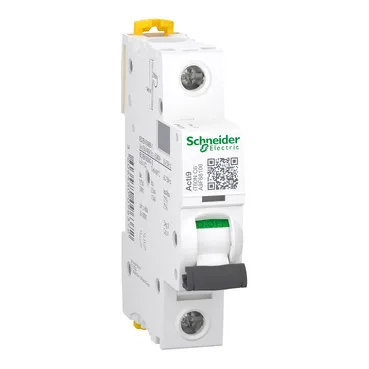
The Schneider Electric A9F68106 is an Acti9 iT60 miniature circuit breaker rated at 6 A, 1-pole, with a C-curve trip characteristic. It carries a 36 kA Icu breaking capacity at 12-60 V AC per EN/IEC 60947-2, which is the figure that governs fault clearing in industrial distribution panels — the 6 kA Icn at 230 V per EN/IEC 60898-1 is the residential/commercial rating.
The C-curve means the magnetic trip fires at 8 x In ±20%, so between 4.8 A and 9.6 A for the instantaneous magnetic element. That suits loads with moderate inrush — small transformers, contactor coils, lighting banks — where a B-curve would nuisance-trip on startup but a D-curve would let a sustained overload run too long. The thermal-magnetic trip unit handles the long-time overload protection; the bimetal element tracks I²t heating. The removable comb busbar mounting mode is standard for Acti9 — the busbar clips into the breaker base, not the terminal screws, so daisy-chaining multiple poles is clean and the torque setting (2 N.m) stays consistent across the row.
Dual-certified to EN/IEC 60947-2 (industrial) and EN/IEC 60898-1 (residential/commercial), so it is accepted in both panel schedules and domestic consumer units.
Integration notes
The removable comb busbar is installed at the factory or field-fitted; the busbar pins engage into the breaker base before the terminal screws are torqued. Wire range is 1-25 mm² rigid or 1-16 mm² flexible, strip length 14 mm, torque 2 N.m. The toggle actuator and trip indicator (red/green flag) are visible through a transparent door or on an open panel. Tropicalisation class 2 per EN/IEC 60068-2-78 means it withstands 95% relative humidity at elevated temperature — relevant for coastal or unconditioned plant rooms where condensation is a concern. Operating altitude is 0-2000 m without derating; above that, dielectric strength and cooling degrade, so consult the thermal derating curves if the panel sits at 3000 m.