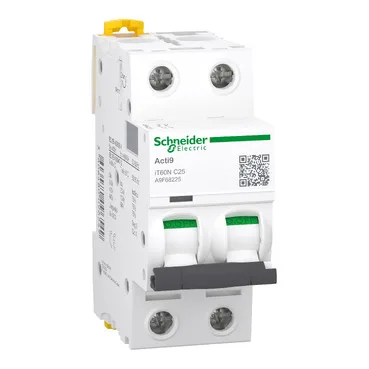
The Schneider Electric A9F68225 is a 2-pole miniature circuit breaker from the Acti9 iT60N series, rated at 25 A with a C-curve magnetic trip characteristic (8 x In ±20%). It's built for distribution panels — DIN rail mounted, 36 mm wide, with a toggle actuator and a trip indicator that shows you at a glance which circuit dropped out. The C-curve means it's meant for general-purpose loads where you get a modest inrush — lighting banks, small motor circuits, control transformers. You can bus it with a removable comb busbar, which keeps the panel wiring clean when grouping several breakers on a common feed.
Breaking capacity — the real-world fault handling
This breaker carries dual ratings under two standards, which matters for selectivity studies and panel SCCR. Under EN/IEC 60947-2 (industrial), it's rated 36 kA Icu at 12–133 V AC, 20 kA at 220–240 V, 10 kA at 380–415 V, and 6 kA at 440 V. Under EN/IEC 60898-1 (residential/commercial), it's rated 10 kA Icn at 400 V. The 36 kA figure at low voltage is unusually high for a 25 A MCB — it'll clear a bolted fault near a large transformer without the arc re-striking. That's the difference between a tripped breaker and a welded contactor.
Environmental and installation specs
Rated for ambient operation from -35 °C to 70 °C, storage from -40 °C to 85 °C, with 95% relative humidity and tropicalisation level 2 per EN/IEC 60068-2-78. That covers most indoor industrial and commercial environments — panel builders in hot, humid plants can install it without derating for condensation. IP20 B finger protection on the front, so it's safe in a closed panel. Rated insulation voltage 500 V AC, overvoltage category IV, and it's certified for isolation use under both 60898-1 and 60947-2. Terminals accept 1–25 mm² rigid or 1–16 mm² flexible wire, with a 2 N·m tightening torque and 14 mm strip length. That's enough for a 25 A feed through 4 mm² or 6 mm² copper — common for sub-main or feeder circuits in a distribution board.