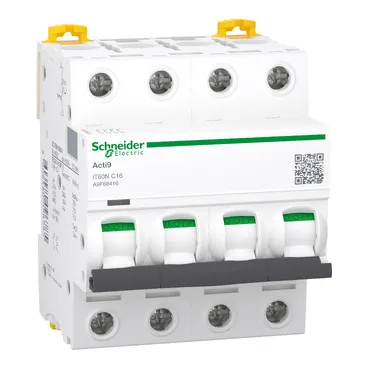
The Schneider Electric A9F68416 is a 4-pole Acti9 iT60 miniature circuit-breaker rated 16 A with a C-curve trip characteristic. It sits on a DIN rail in a distribution board, protecting a 4-wire circuit (three phases plus neutral) against overload and short-circuit. The 72 mm width (8 x 9 mm pitches) is the standard 4P footprint — it occupies four adjacent module positions in the enclosure, so plan your rail fill accordingly. The C-curve means the magnetic trip fires at 8 x In ±20 %, i.e. between roughly 102 A and 154 A for this 16 A breaker. That suits mixed loads with moderate inrush — think general distribution, lighting banks, contactor coils, small motor circuits. If your load has high inrush (transformers, large motors) you would step to a D-curve; for purely resistive loads a B-curve gives tighter protection. The thermal-magnetic trip unit handles the overload side with a bimetal element and the short-circuit side with a solenoid. At 220–240 V AC it interrupts 20 kA Icu; at 380–415 V AC it manages 10 kA Icu; and at 12–133 V AC it holds 36 kA Icu. The Icn rating under EN/IEC 60898-1 is 6 kA at 400 V AC. For a typical European distribution board fed from a 250 kVA transformer, the prospective short-circuit current at the main switch is often 10–25 kA — this breaker covers that range comfortably at 240 V and is adequate at 415 V for most sub-distribution positions. Check your utility-declared fault level before committing the BOM line.
Terminals accept 1–25 mm² rigid or 1–16 mm² flexible copper, with a tightening torque of 2 N.m. Strip the wire to 14 mm. The ambient operating range is -35 to 70 °C, storage -40 to 85 °C, with 95 % relative humidity and tropicalisation class 2 per EN/IEC 60068-2-78.