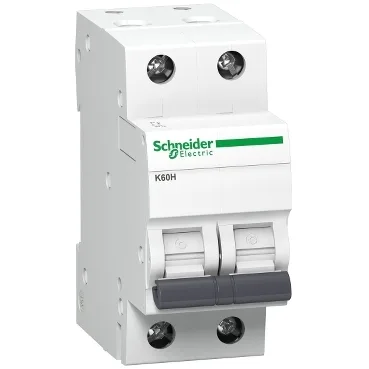
The Schneider Electric A9KF71201BQ is a 2-pole Acti9 K60 miniature circuit breaker rated at 1 A with a C-curve trip characteristic, meaning it trips magnetically between 5 and 10 times the rated current — useful for protecting smaller branch circuits against short circuits and moderate overloads in residential or light commercial AC distribution panels.
For a 1 A circuit, that's plenty of headroom; the limiting factor in a real panel is usually the upstream device's selectivity, not the breaker's own rating. The C-curve magnetic trip (5–10 x In) means this breaker tolerates moderate inrush — think a handful of LED drivers, control transformers, or small contactor coils — without nuisance tripping. If you're protecting a purely resistive load or a sensitive electronic circuit, a B-curve (3–5 x In) would be a better fit; for motor-starting inrush, you'd want a D-curve (10–20 x In). At 1 A rated current, this is a low-current MCB — sized for control circuits, signal loops, or very small lighting strings, not for power feeders. The thermal-magnetic trip unit handles sustained overloads via the bimetal strip and fast short-circuits via the solenoid, a proven combination for distribution duty.
Snaps onto a standard DIN rail (35 mm) and occupies 4 x 9 mm pitches (36 mm wide) — a compact 2-pole footprint that fits neatly into a residential or light commercial load center. Height is 81 mm, depth is 70 mm, so it sits flush with other Acti9 devices in the same row. That's enough for a 1 A circuit's wiring, but the terminal range also allows daisy-chaining if needed.
Compliance is straightforward: it meets EN/IEC 60898-1 for miniature circuit breakers, with tropicalisation class 2 per IEC 60068-1 (handles humidity up to 95% at 55 °C) and pollution degree 2. It's also suitability for isolation certified — meaning you can safely use it as a disconnecting means for a downstream circuit, provided the load current doesn't exceed 1 A.