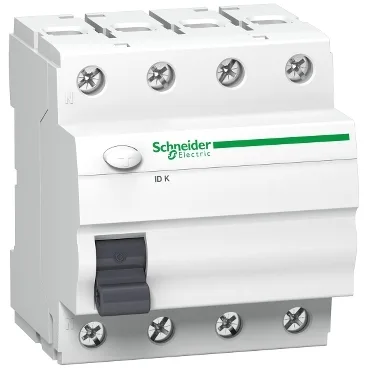
The Schneider Electric A9KR15440 is a 4-pole residual current circuit breaker (RCCB) from the Acti9 ID K range, rated 40 A with 100 mA earth-leakage sensitivity, Type AC, instantaneous trip. It sits on a DIN rail via clip-on mounting, sized for group incomer duty in a 50 Hz AC network with a rated operational voltage of 380...415 V AC. The 100 mA sensitivity means it detects leakage currents at that threshold and trips instantaneously — no intentional delay — so it's suited for circuits where fast disconnection on earth fault is required, not for selectivity coordination with downstream delayed RCCBs.
The 40 A rated current (In) governs the continuous load the RCCB can carry without tripping on overload — sized for a 40 A feeder or submain. The 100 mA sensitivity (IΔn) is higher than the typical 30 mA used for personal protection; it's intended for equipment protection or circuits where nuisance tripping from natural leakage (long cable runs, surge suppression) would be a problem. The Type AC classification means it only detects sinusoidal AC residual currents — not pulsating DC or smooth DC — so it's limited to circuits where the fault current is purely AC (resistive heaters, simple motor loads with no half-wave rectification). Breaking capacity is listed as Idm 500 A / Im 500 A — this is the rated short-circuit making and breaking capacity for the RCCB under the product standard EN/IEC 61008-1. That 500 A figure applies to the fault current the device can safely interrupt; it's not a high-fault-level device, so upstream overcurrent protection (MCB or fuse) must limit the prospective short-circuit current to within this value. Pollution degree 2 (normal, non-conductive pollution) and IP20 (finger-safe, no water ingress) are standard for indoor distribution boards. The 9 mm pitch spans 8 modules (72 mm width), so it occupies 8 DIN-rail modules — check the enclosure fill before specifying.
Wire stripping length is 14 mm for both top and bottom connections. The toggle control is manual; there is no contact position indicator, so visual confirmation of the contact state requires a separate auxiliary contact block if needed for remote indication.