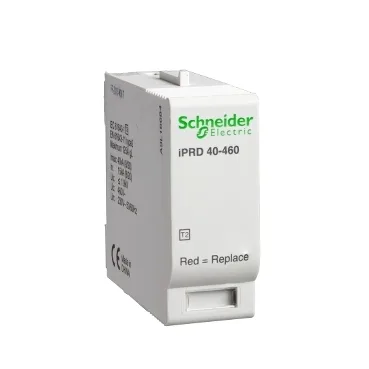
The Schneider Electric A9L16688 is a Type 2 surge arrester cartridge from the Acti9 range, designated C8-460. It's the replaceable MOV element that plugs into the iPRD base — the part that actually takes the hit when a surge comes down the line. Rated for 230 V AC at 50 Hz, it handles a maximum discharge current of 8 kA and a nominal discharge current of 2.5 kA, with a voltage protection level below 1.6 kV and a response time under 25 ns. That sub-25 ns clamp speed is what keeps the transient off sensitive downstream equipment before it can do damage.
Let me walk through what these numbers actually tell you about where this cartridge fits. The Type 2 classification (per IEC 61643-1 and EN 61643-11) means it's designed for the main distribution board — it handles induced surges from switching or indirect lightning strikes, not direct hits. The 8 kA maximum discharge current is the big one: that's the surge it can survive once before needing replacement. The 2.5 kA nominal discharge current is what it sees in normal service — think repetitive switching transients from motors or capacitor banks in an industrial plant. The <1.6 kV protection level means that even with a full 8 kA surge, the voltage let-through stays below 1.6 kV, which keeps downstream equipment with a 2.5 kV impulse rating safe. And the <25 ns response time? That's the MOV doing its job — clamping the spike before it propagates past the SPD.
IT earthing and panel fit
One detail that matters if you're working on an ungrounded system: this cartridge is rated for IT earthing systems (isolated or impedance-grounded neutral). That's less common in North America but standard in European hospital, mining, or continuous-process plants where you want to keep running after a first fault. The cartridge itself is 18 mm wide, 50 mm high, 60 mm deep — it plugs into the iPRD base, which then snaps onto a DIN rail. The white (RAL 9003) housing with the red/white flag indicator lets you see at a glance whether the MOV has blown.
Environmental limits and compliance
Operating temperature range is -25 to 60 °C, storage from -40 to 85 °C, with relative humidity from 5 to 90%. Operating altitude goes up to 2000 m — fine for most installations but worth checking if you're at high elevation. The housing is PBT (polybutylene terephthalate), which holds up well in industrial atmospheres. Compliance is to IEC 61643-1 and EN 61643-11; the evidence doesn't list UL or CSA marks, so if you need those for a North American panel, verify before committing the BOM line.