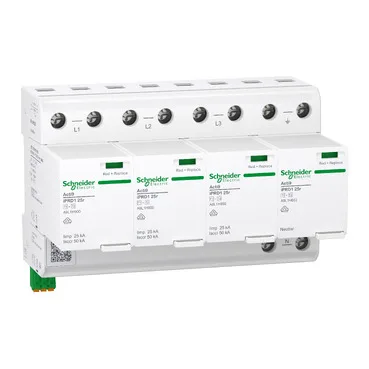
The Schneider Electric A9L1H625 is an Acti9 iPRD1 Type 1+2 surge arrester with a pluggable cartridge, rated for 25 kA impulse current per pole in differential mode and 100 kA in common mode. It clips onto a DIN rail, occupies 16 modular pitches (144 mm wide), and stands 110.5 mm tall with a depth of 86 mm. This is the 3P+N variant, designed for TT and TN-S earthing systems, and carries VDE quality certification.
Type 1+2 classification means it handles both direct lightning strikes (10/350 µs waveform, 25 kA Iimp) and switching transients (8/20 µs, 65 kA Imax) in one package — no need for a separate Type 1 and Type 2 device in series. The MOV + GDT technology (metal-oxide varistor plus gas discharge tube) gives it a follow-current extinguishing capability of 100 A on the N/PE path, which is critical for TN-S systems where the neutral-to-earth path must clear without nuisance tripping upstream breakers. Response time under 100 ns catches fast transients before they reach sensitive downstream electronics. That's a standard coordination for Type 1 arresters in main distribution boards. The pluggable cartridge design lets you swap a spent module without rewiring the base, which matters when you're trying to restore protection fast after a surge event.
Clip-on DIN rail mounting, 16 pitches wide at 9 mm each — that's 144 mm of rail space. It's a distribution-board device, meant for the main or sub-main panel where the service entrance cable lands. The IP20 rating (with cartridges fitted and wired) is fine for enclosed panels; keep the panel door closed during operation. The IK05 impact rating means it can handle a 0.7 J knock during installation without cracking the thermoplastic housing. Wire range is generous: power terminals accept 6–35 mm² solid or stranded, earthing terminal up to 35 mm² solid. Strip length is 18 mm for power and earth, 10 mm for the remote-signal wires. Torque the power connections to 4.5 N·m — that's a standard M6-ish terminal, so a decent screwdriver and a torque driver are in order. The remote-signal contact uses 0.25–1.5 mm² solid cable.