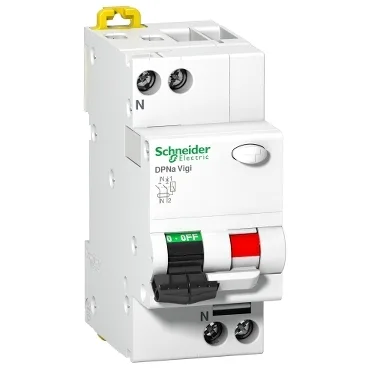
Rated 16 A at 30 °C with a C curve magnetic trip (5–10 × In), it breaks 6000 A Icn at 230 V AC per EN 61009. The 10 mA Type A residual-current element catches sinusoidal and pulsating DC fault currents — the sensitivity level specified for circuits supplying socket outlets in residential and commercial final subcircuits where additional protection against electric shock is required.
Type A detection means the unit responds to AC residual currents and pulsating DC waveforms — the minimum requirement for circuits feeding single-phase electronics, washing machines, or LED drivers that generate half-wave fault currents. The 10 mA sensitivity is the highest-gain standard threshold; it trips before leakage reaches a level that could fibrillate the heart, so it is used on circuits supplying wet areas (bathrooms, kitchens) or medical locations, but nuisance tripping on long cable runs with capacitive leakage is a real risk — keep the downstream load capacitance under the trip threshold. The C curve magnetic release operates between 5 and 10 times In (80–160 A for the 16 A unit), so it tolerates the inrush of small motors, transformers, and capacitive loads without nuisance tripping while still clearing a hard short. If your installation has a higher fault level upstream, you need a current-limiting upstream MCB or a higher-rated RCBO. Thermal-magnetic trip technology means the thermal bimetal handles sustained overloads (time curve inverse with current) while the solenoid handles short-circuits. The 20 000-cycle electrical and mechanical endurance is typical for a residential-grade device — fine for normal switching duty, but not for frequent on/off control of a load.
Snaps onto standard DIN rail. The 1P+N form factor occupies 4 × 9 mm pitches (36 mm) — one module width for the phase pole plus a switched neutral on the left side. The toggle gives local ON/OFF indication.