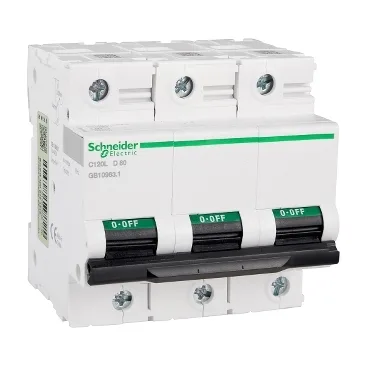
The Schneider Electric A9N19846 is an Acti9 C120L miniature circuit breaker (MCB) with three poles, rated at 80 A at 30 °C with a D trip curve. Its 15 kA breaking capacity at 400 V AC (Icn per EN/IEC 60898-1, Icu per EN/IEC 60947-2) means it handles high-fault-current industrial distribution panels — the D curve (12 x In magnetic trip) suits loads with high inrush, like motor starters or transformer primaries, where a B or C curve would nuisance-trip. Clip-on DIN rail mounting, tunnel terminals accepting up to 50 mm² rigid, and a toggle with ON/OFF indication make it a straightforward panel fit.
This part is obsolete per the manufacturer's lifecycle status. The dual-standard certification (GB 10963.1 / EN/IEC 60898-1 and GB/T 14048.2 / EN/IEC 60947-2) means it was qualified for both residential and industrial applications, so any replacement must match the 15 kA Icu/Icn at 400 V and the D-curve magnetic threshold to maintain selectivity and SCCR in the existing panel.
Within the Acti9 C120 family, the D-curve variant is the one you specify when the downstream load draws a repetitive inrush peak — think motor contactors, small transformers, or discharge lamps. A C-curve C120 of the same frame would trip on that inrush; the D-curve's 10–14 x In magnetic threshold (12 x In ± 20 % per GB/T 14048.2) holds through the start transient and clears only on a sustained overload or hard short. If your panel's load is purely resistive or general-purpose, a C-curve is cheaper and more sensitive — but for motor circuits, the D curve is the correct call.