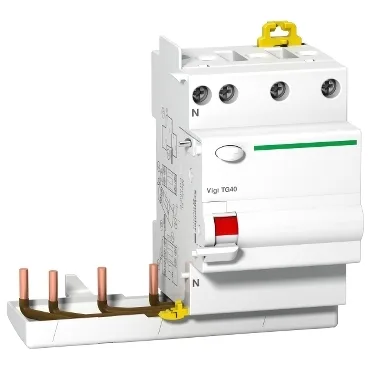
The 25 A rated current (In) sets the maximum continuous load the RCD can carry — sized for a group incomer feeding several downstream branch circuits, not a single heavy load. The 300 mA sensitivity is a common choice for protection against fire risk from earth faults rather than personnel shock protection (which typically requires 30 mA or lower). Type AC means it detects only sinusoidal AC residual currents; if your installation includes non-linear loads (VFDs, switched-mode supplies) that can generate pulsed DC fault currents, you would need a Type A or Type B device instead. The voltage-independent tripping mechanism is a plus for reliability: the RCD will still trip on a residual fault even if the phase-to-neutral voltage collapses.
Clip-on mounting to DIN rail — it snaps onto the rail alongside the associated MCB and connects electrically via screws. The 3P+N configuration with neutral on the left means it occupies 6 module pitches of 9 mm each, so plan for 54 mm of DIN-rail width. Rated insulation voltage is 400 V AC phase-to-phase at 50 Hz, with an impulse withstand voltage of 6 kV, so it is suited for standard 400/230 V distribution panels.