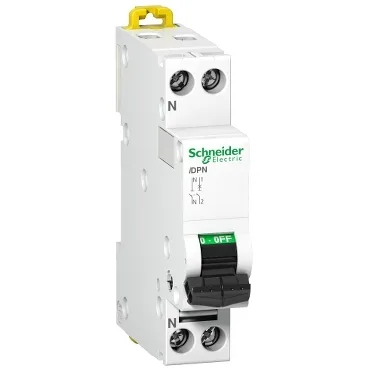
It protects a single pole plus neutral (1P+N) in AC distribution circuits up to 230 V, where it interrupts faults at 4500 A Icn per EN/IEC 60898-1.
The 32 A rating governs the continuous load the breaker can carry without nuisance tripping at 30 °C ambient. For a panel builder wiring a lighting or general-purpose socket circuit, that is the sizing anchor: the downstream cable must be rated for at least 32 A, and the load should not exceed 32 A continuously. The C-curve (magnetic trip at 5–10× In) means it tolerates the inrush of small motors, transformers, or fluorescent ballasts — a B-curve breaker would trip on the same start current. The 4.5 kA breaking capacity at 230 V AC is the maximum prospective fault current the breaker can safely interrupt; if the available fault current at the panel exceeds 4.5 kA, this breaker is not the right choice — step up to a higher-rated MCB or add a current-limiting upstream device.
The 18 mm width per pole — two 9 mm pitches for the 1P+N unit — means it occupies two module spaces in the enclosure. Tunnel-type terminals accept flexible cable 0.33–10 mm² or rigid 0.75–16 mm²; strip length 13 mm, tighten to 2 N·m. Neutral is on the left.