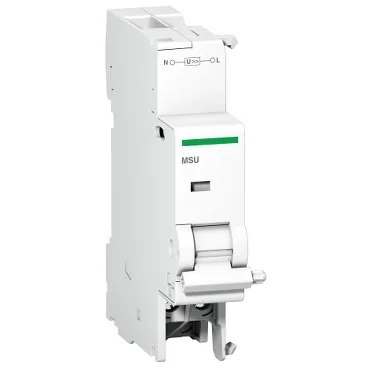
It monitors the control circuit at 230 V AC 50/60 Hz and trips according to a stepped curve: 255-275 V in 3-15 s, 300 V in 1-5 s, 350 V in 0.25-0.75 s, and 400 V in 0.07-0.2 s. That means it catches sustained swells before they damage downstream equipment, while ignoring brief transients that wouldn't harm anything.
At 18 mm wide (2 x 9 mm pitches), it occupies a single module slot. Depth is 73.5 mm, height 82.5 mm. Tightening torque is 1 N·m; strip length 9-10 mm. Top-side comb busbar compatible.
This part is marked obsolete by the manufacturer. If you're freezing a new design, look at the current Acti9 overvoltage release range; the iMSU form factor and trip characteristics have evolved, so verify the trip curve and DIN footprint against your panel layout.
Built to EN 50550, the European standard for power-frequency overvoltage protective devices (POPs). CE marked. The local action indicator gives a visual trip signal, which helps during fault-finding without needing to meter the circuit.