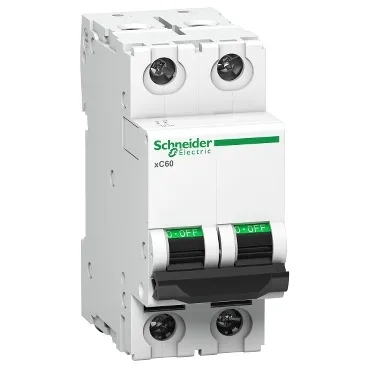
The D curve means the magnetic trip fires at 10 to 14 times the rated current (200–280 A for this 20 A unit). The thermal-magnetic trip element handles the overload side; the magnetic coil clears short-circuits.
Breaking capacity — what it can interrupt
Breaking capacity is 10,000 A Icn at both 240 V and 415 V AC, 50/60 Hz, certified to IS/IEC 60898-1. That's a single rating that holds across the common single-phase and three-phase supply voltages in industrial and commercial distribution. Rated operational voltage is 220...240 V AC or 380...415 V AC, 50/60 Hz. The 2-pole construction protects both phase conductors in a single-phase circuit, or one phase plus neutral in a TN system where the neutral is switched. Overvoltage category IV means it's rated for the main distribution point — not just downstream sub-circuits.
Terminals and wiring
Biconnect terminals allow two conductors per pole — handy for daisy-chaining or feeding through to a downstream device without a separate terminal block. That's standard for this class; a common 3.5 mm flat-blade screwdriver works. The toggle gives a clear ON/OFF indication (local signalling). Mechanical and electrical durability are both rated at 20,000 cycles — that's the expected life under normal switching conditions, not just fault clearing. For a distribution MCB that mostly sits closed, that's effectively a lifetime rating.