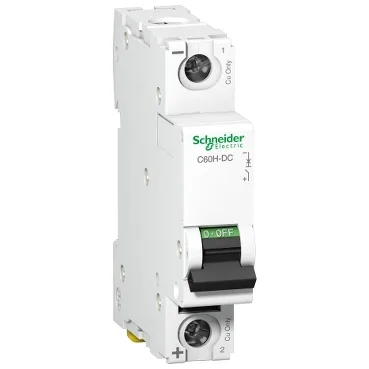
DC-rated miniature circuit-breaker for distribution panels
The Schneider Electric A9N61514 is a 1-pole Acti9 C60H-DC miniature circuit-breaker rated 30 A at 25 °C, with a C-curve trip characteristic and thermal-magnetic technology. The breaker occupies 2 x 9 mm pitches (18 mm) of panel width. Breaking capacity is specified per IEC/EN 60947-2: 10 kA Icu at 220 V DC, 6 kA Icu at 250 V DC, and 20 kA Icu at 110 V DC. The service breaking capacity Ics is 75 % of Icu at each voltage level — 7.5 kA at 220 V DC, 4.5 kA at 250 V DC, and 15 kA at 110 V DC. That means after clearing a fault at the Ics level, the breaker remains functional for continued service, not just a one-shot trip. Rated operational voltage is 250 V DC, with an insulation voltage of 500 V DC and impulse withstand of 6 kV. Overvoltage category IV and pollution degree 3 suit it for main distribution panel environments where transient overvoltages are expected.
What the C-curve and DC ratings mean for your circuit
The C-curve (trip threshold 5 to 10 times In) is standard for inductive or moderate inrush loads — think DC motor drives, solenoid banks, or control transformers where the start-up current exceeds the steady-state rating but stays within a predictable band. For a 30 A breaker, magnetic trip occurs between 150 A and 300 A. DC arc extinction is fundamentally different from AC — there is no natural zero-crossing to quench the arc. The C60H-DC's arc chamber and contact gap are engineered for DC interruption, certified to EN/IEC 60947-2. For a 48 V DC telecom bus or a 110 V DC control panel, the 20 kA Icu provides substantial headroom. Suitability for isolation per IEC 60947-2 is confirmed — the contact position indicator and padlockable toggle (lockable in the O position) provide visible break and lockout/tagout capability. This matters for a DC panel where an upstream isolator may not be present.
Environmental and installation limits
Tropicalisation class 2 per IEC 60068-2 indicates the breaker is treated for resistance to heat and humidity — relevant for panels in non-conditioned spaces or near process heat. Altitude derating applies above 2000 m. Terminal torque spec is 2.5 N·m for the power circuit, top or bottom. The spring-cage terminals accept standard copper conductors; strip length and ferrule sizing per the manufacturer's installation guide. The 35 mm DIN rail mount is fixed — no clip-on or plug-in base. Mechanical endurance is rated at 20,000 cycles; electrical endurance at 3,000 cycles with a load time constant L/R = 2 ms. That electrical figure is the limiting factor for frequent switching applications — if the breaker cycles daily under load, plan for replacement well before the mechanical life is reached.