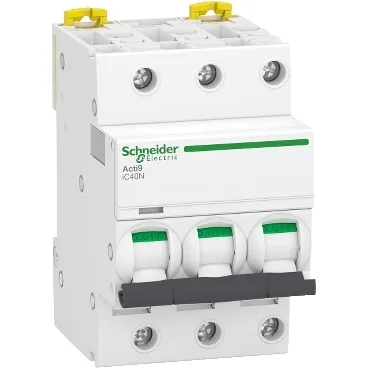
The Schneider Electric A9P54340 Acti9 iC40N is a 40 A, 3-pole miniature circuit breaker with a C curve — the standard choice for general-purpose distribution in residential and light commercial panels where moderate inrush (motors, transformers, lighting) is expected. The C curve's magnetic trip threshold of 5 to 10 times In (5–10 x In per EN/IEC 60898-1, with a tighter 8 x In ±20 % per EN/IEC 60947-2) means it holds through the startup surge of a 40 A-rated motor or capacitor bank without nuisance tripping, yet still clears short circuits fast enough to protect downstream wiring. Breaking capacity is 10 kA Icu at 400 V AC (EN/IEC 60947-2) and 6 kA Icn at 400 V AC (EN/IEC 60898-1). The 6 kA Icn rating satisfies domestic and light commercial installations per the domestic standard. Both ratings are verified at 50/60 Hz. Clip-on mounting to DIN rail (35 mm per EN 60715) and tunnel terminals accepting 1–16 mm² rigid or 1–10 mm² flexible wire make it a drop-in replacement for any 3P MCB in a standard distribution board. The 54 mm width (6 x 9 mm pitches) fits a standard 3-pole module footprint. IP20 finger-safe terminals; IP40 in a modular enclosure.
Dual-rated to EN/IEC 60898-1 (domestic MCB standard) and EN/IEC 60947-2 (industrial circuit-breaker standard), so it qualifies for both residential DBs and industrial sub-distribution. Limitation class 3 per 60898-1 means it limits let-through energy under fault conditions — reduces stress on downstream equipment. Pollution degree 3 per 60947-2 suits it for environments with conductive pollution (e.g., control rooms near industrial processes). Quality labels include OVE (Austria) and AENOR (Spain).
Mounts via clip-on to DIN rail — no screws, no tools beyond a screwdriver for the tunnel terminals. The toggle actuator provides ON/OFF indication plus a trip indicator (red flag when the breaker has tripped on fault). Padlocking device available for lockout/tagout. Rated for 10,000 electrical cycles and 20,000 mechanical cycles — typical for a distribution MCB in a panel that sees infrequent switching (most cycles come from fault clearing and maintenance isolation, not daily operation).