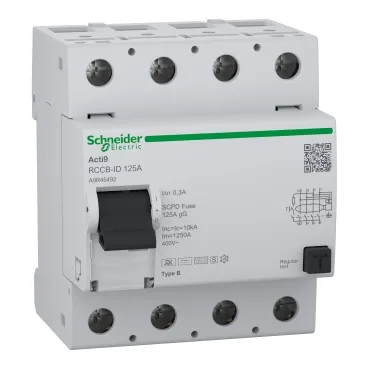
The 125 A rating means it handles the full load current of a large submain or outgoer feeding multiple downstream circuits — sized for a 3-phase 400 V supply where the total connected load pushes past 80 A. The 300 mA sensitivity is a deliberate choice: it's not for personnel protection (that needs 30 mA or below); it's for fire protection and equipment protection on circuits where nuisance tripping from normal leakage would shut down a process line. The Type B classification means it detects AC, pulsating DC, and smooth DC fault currents up to 1 kHz — essential on circuits with variable-speed drives, UPS systems, or rectifiers that can produce DC leakage that a standard AC or Type A RCCB would miss. The selective (time-delayed) characteristic means this RCCB will not trip on short-duration leakage pulses that downstream RCCBs should clear — it coordinates selectivity so that a fault on a branch circuit trips the branch device, not this main switch. This is critical in a distribution board where you want the main RCCB to stay in while a downstream 30 mA RCCB clears a ground fault on a socket outlet.
The 4-pole (4P) configuration with neutral on the left occupies 8 x 9 mm pitches, so 72 mm width. The tunnel-type terminals accept up to 50 mm² rigid cable or 35 mm² flexible — that's a 1/0 AWG equivalent, sized for the 125 A feed. Tightening torque is 3 N·m; wire strip length 11 mm. The toggle control gives a clear on/off position, and the red/green trip indicator shows whether the device has tripped on leakage — no need to guess.