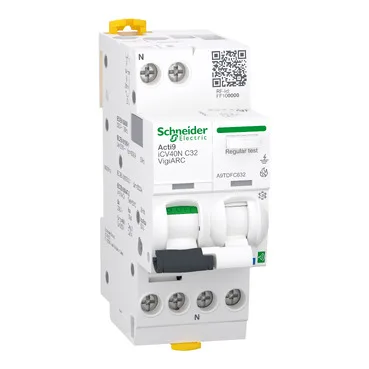
The Schneider Electric A9TDFC632 is an Acti9 Active iCV40N ARC RCBO — a combined residual current device with overcurrent protection, rated 32 A with a C-curve trip characteristic, 1P+N poles, and a 6 kA Icn / 10 kA Icu breaking capacity at 230 V AC. The 'ARC' designation means it includes arc-fault detection, not just earth-leakage and overload — it watches for the high-frequency signature of a series or parallel arc and trips before the arc can start a fire.
The 32 A C-curve is the standard choice for general-purpose socket-outlet circuits and small inductive loads — the magnetic trip threshold sits at 5 to 10 times In (160–320 A), so it won't nuisance-trip on motor inrush or capacitor charging. The 6 kA Icn is the service breaking capacity per EN/IEC 61009-2-1; the 10 kA Icu per EN/IEC 60947-2 is the ultimate breaking capacity, meaning the device can safely interrupt a 10 kA fault once and still hold its insulation. For a domestic or light commercial distribution board with a typical upstream fault level under 6 kA, the N breaking-capacity code is adequate. The thermal-magnetic trip unit uses a bimetal for overload and a solenoid for short-circuit — no electronics in the trip path, so it's immune to supply-voltage dips. The arc-fault detection (AFDD function) complies with EN/IEC 62606. It measures both the current waveform and the high-frequency noise that a loose connection or damaged cable generates. The local signalling includes a dedicated LED for arc-fault diagnostic — useful when a nuisance trip happens and you need to know whether it was a real arc or a false positive from a brush motor. The device also handles overvoltage, earth leakage, and overload events, with a toggle for manual on/off and fault reset. Accuracy for the measurement functions is stated as voltage ±2%, current ±2%, and power ±5%. That's fine for load monitoring and energy allocation; not metering-grade, but enough to tell you which circuit is drawing what. The tropicalisation rating (severity B per IEC 60068-2-30 for 28 days) means it survives hot, humid environments without internal condensation damage — relevant for enclosures in laundries, greenhouses, or coastal plant rooms.
Pollution degree 2 (non-conductive dust, occasional condensation) and overvoltage category III (distribution-board level) define its installation environment.