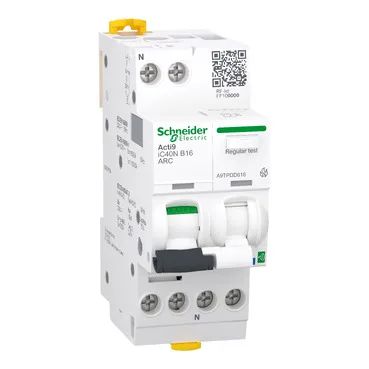
It protects a final subcircuit against overload, short-circuit, and series or parallel arc faults, which standard MCBs don't detect. Breaking capacity is 3000 A Icn per EN/IEC 60898-1 and 10 kA Icu per EN/IEC 60947-2 at 230 V AC, 50 Hz — enough for most domestic and small commercial installations where fault current stays below 3 kA prospective.
Clip-on mounting to DIN rail, 36 mm wide (4 x 9 mm pitches), 91 mm tall, 73 mm deep. Neutral on the left, cable entry top and bottom. IP20 rated — suitable for dry indoor enclosures only, not washdown or outdoor exposure.
For a 16 A circuit, that's a fast trip on a hard short but tolerates the inrush of incandescent lamps or small transformers without nuisance tripping. If you're feeding motor loads or drives, a C or D curve would be a better fit — but this part is B curve, so keep it on general-purpose final circuits. Limitation class 3 means it lets through very little energy during a short-circuit — downstream equipment sees less thermal and magnetic stress. That's a real advantage if you've got sensitive electronics on the same sub-board. Arc-fault detection is the main event here: it monitors for series (loose connection) and parallel (carbonised insulation) arcs and trips within a defined time. The local signalling includes an LED for arc-fault diagnostic, plus ON/OFF/fault trip indicators. Combined with the electrical data recording (date/time stamp and maintenance counters), it helps a service tech trace intermittent faults that a standard MCB would never flag.