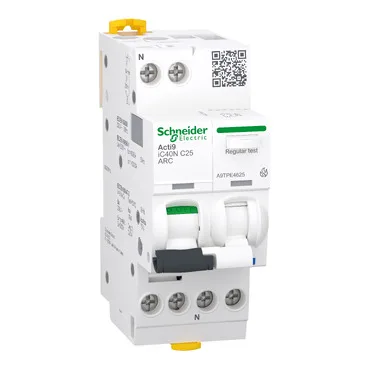
Arc fault detection circuit breaker, 25 A, C-curve
Breaking capacity is three-tier: 3 kA Icn1 and 6 kA Icn per EN/IEC 60898-1, plus 10 kA Icu per EN/IEC 60947-2 at 230 V AC. That Icu rating matches the industrial standard for fault-clearing capability — the part can safely interrupt a 10 kA prospective fault current without welding contacts, so it coordinates cleanly with upstream MCCBs or fuses in a distribution board. The thermal-magnetic trip unit is the same proven mechanism used across the Acti9 range — no surprises on coordination curves if you're already specifying iC40 breakers. The arc-fault detection electronics monitor the waveform for high-frequency noise characteristic of series arcs; a red LED on the toggle indicates an arc-fault trip, which helps during commissioning or fault-finding.
Clip-on mount to 35 mm DIN rail per EN 60715, occupying a single 36 mm width (2 x 18 mm modules). The 1P+N configuration places the neutral on the left, with cable entry from top or bottom — tunnel terminals accept 1–10 mm² flexible or 1–16 mm² rigid, tightened to 2 N·m. Strip length 14 mm. That's a standard footprint for a single-pole-plus-neutral AFDD; no extra space needed beyond what a typical MCB/RCBO occupies. Depth is 73 mm, height 91 mm — fits flush in most DIN-rail enclosures with the door closed. IP20 finger-safe terminals; pollution degree 2, suitable for clean, dry indoor panels. The white (RAL 9003) housing matches the Acti9 family aesthetic.
Standards compliance covers EN/IEC 60898-1 (MCB), EN/IEC 60947-2 (industrial circuit-breaker), and EN/IEC 62606 (arc-fault detection devices). Quality labels include AENOR and OVE. Tropicalisation severity B per IEC 60068-2-30 for 28 days — the part is tested for high-humidity environments, which matters if the panel sits in a non-conditioned space.