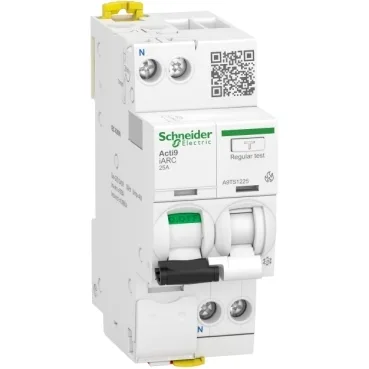
Arc fault detection switch for final circuits
The Schneider Electric A9TS1225 is an Acti9 iARC arc fault detection switch rated 25 A at 230-240 V AC, 50 Hz, per IEC 62606. The 1P+N configuration places the neutral on the left, with top and bottom cable entry for straightforward panel wiring. Rated insulation voltage is 250 V AC between phase and neutral, 400 V AC between phases.
The 25 A rated current (In) is the continuous thermal rating at 30 °C ambient — the device will carry that load indefinitely without tripping. For arc fault detection, the trip curve is not a standard B/C/D MCB curve; it responds to the high-frequency signature of an arc, not to overload or short-circuit current. That means it must be coordinated with an upstream MCB or RCBO that handles the overcurrent protection. Electrical durability is 10,000 cycles at rated load (240 V AC, 50 Hz) per IEC 62606; mechanical durability is 20,000 cycles. For a switch that may only operate a few times a year in normal service, that is generous — the limiting factor is the contact wear from arc-fault interruptions, not the switch's own switching life. The IP20 finger-safe terminals (IEC 60529) mean it is protected against solid objects over 12 mm but not against water ingress — standard for indoor distribution boards. The tropicalisation rating (Severity B, 28-day damp heat per IEC 60068-2-30) confirms it can handle high-humidity environments without internal corrosion, which matters for coastal or unconditioned electrical rooms.
For BOM freeze or second-source planning, note that the iARC is a dedicated arc-fault detection switch — not a combined MCB/arc-fault device. If your design requires a combined unit (AFDD+MCB), Schneider offers the iC60 with Vigi add-on blocks, but those are different order codes and a different form factor. The A9TS1225 is the standalone AFDD for retrofit or new install where the overcurrent protection is already provided upstream.
Clip-on mounting to DIN rail (35 mm) — no screws needed. The 36 mm width (2 x 18 mm modules) means it occupies two adjacent slots in the consumer unit. The toggle control provides local ON/OFF and fault-trip indication. The neutral position is left, so plan the busbar routing accordingly.