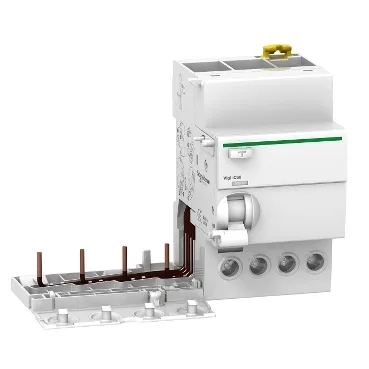
Rated 25 A with 30 mA sensitivity, AC type, it provides earth leakage protection for a 4-pole (4P) circuit on a 400 V AC network, 50/60 Hz. The 30 mA sensitivity is the standard threshold for personal protection against direct-contact shock in residential and commercial final circuits, while the instantaneous trip characteristic means it clears a fault within the first half-cycle — no intentional delay for selectivity.
The 25 A rated current (In) sets the maximum continuous load the RCD can carry without thermal derating in a 40 °C ambient; the protected circuit's design load must stay below this. The 30 mA sensitivity is the trip threshold for earth leakage current — any imbalance between phase and neutral exceeding 30 mA will cause the device to open within the instantaneous response time. This is the standard for socket-outlet circuits in most IEC-based wiring regulations, providing protection against direct contact with live parts. The voltage-independent tripping technology means the RCD will operate even if the supply voltage is lost — the trip mechanism draws its energy from the fault current itself, a requirement for safety in circuits where the neutral may be interrupted.
The A9V11425 clips onto a DIN rail (35 mm) and occupies 6 module pitches (54 mm). It is an add-on block that screws directly to the outgoing side of an iC60 MCB — the electrical connection is made via the screw terminals on the bottom of the RCD, which accept rigid cable up to 25 mm² or flexible cable up to 16 mm² with or without ferrules.
The A9V11425 is designed and tested to EN 61009-1 and IEC 61009-1, the standards for residual current operated circuit breakers with integral overcurrent protection (RCBOs) — though this is an add-on block, not a combined unit, the RCD portion follows the same test regime. The device also carries an 8/20 µs impulse withstand rating of 250 A, meaning it can survive a lightning-induced surge current on the residual current path without nuisance tripping or damage.