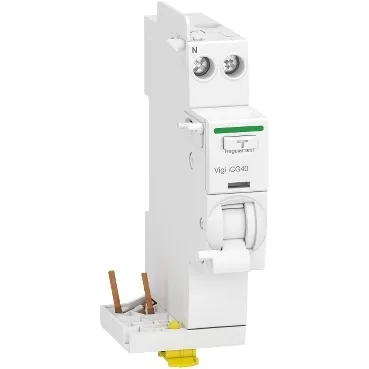
This is the group-incomer variant, meaning it's sized for the incoming feed to a sub-distribution board, not an individual final circuit. The 300 mA sensitivity is the key spec here: that's the standard threshold for fire-protection RCDs (not personnel protection, which is 30 mA). It's meant to detect insulation degradation and arcing faults before they escalate into a fire, while avoiding nuisance trips from normal leakage on a group of circuits. The Type A classification means it handles pulsating DC residual currents — common from switch-mode supplies, VFDs, and electronic loads — not just pure sinusoidal AC faults. The voltage-independent trip mechanism is a reliability feature: the RCD stores enough energy from the fault itself to open the contacts, so it still provides earth-leakage protection even if the neutral is lost or the supply voltage drops. That's a meaningful difference from electronically-triggered RCDs that need an auxiliary supply to trip.
Wire range is 1 to 16 mm² rigid or 1 to 10 mm² flexible, with a 14 mm strip length. The tunnel-type terminals accept standard panel-building wiring. IP20 on the terminals (finger-safe), IP40 on the modular enclosure — standard for distribution boards. That's the typical environment inside an industrial panel not sealed to IP54.
The Acti9 platform is Schneider's active residential and light-commercial DIN-rail range; the Vigi iCG40 is a standard catalog item.
IMQ quality mark. Rated insulation voltage 400 V AC, impulse withstand voltage 4 kV. Relative humidity 95% at 55 °C. Maximum operating altitude 2000 m.