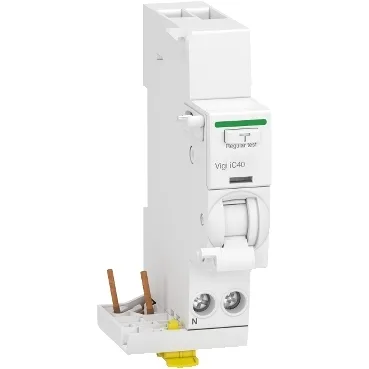
The 25 A rated current matches the MCB it sits behind — you pair this RCD with a 25 A Acti9 MCB (like the iC40N) and screw it on using the tunnel terminals (1–16 mm² rigid, 1–10 mm² flexible). The 300 mA sensitivity is the standard for protection against fire from earth faults in fixed wiring; it's less sensitive than 30 mA (which protects people), so it's suited for circuits where nuisance tripping from leakage is a concern, like groups of office equipment or small distribution boards. Type A detection means it handles both sinusoidal AC residual currents and pulsating DC — common with electronics, switched-mode power supplies, and variable-speed drives. The voltage-independent tripping technology means the RCD works even if the neutral is lost or the voltage drops, which is a reliability plus for safety circuits. Instantaneous trip (no time delay) means it clears faults within the standard 300 ms window, so it coordinates with upstream selective RCDs if you need discrimination. Pollution degree 3 and IP20 (finger-safe) make it suitable for clean indoor panels; the IP40 modular enclosure rating means it's fine inside an enclosed distribution board. Mechanical durability of 20,000 cycles and electrical durability of 10,000 cycles are typical for an RCD in this class — fine for a fixed installation where it's operated only during testing or fault clearing, not for frequent switching duty.
Standards compliance includes EN/IEC 61009-2-1 (RCDs for household and similar uses) and quality marks OVE and IMQ, which cover the Austrian and Italian markets. The 4 kV impulse withstand voltage (Uimp) gives decent surge margin for typical TN and TT systems.