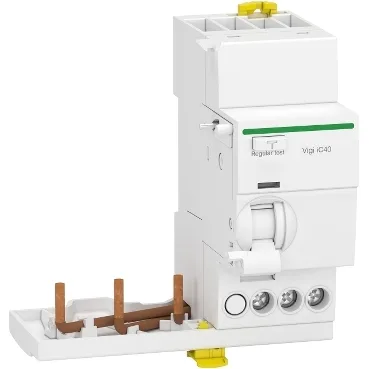
The Schneider Electric A9Y84340 is an Acti9 Vigi iC40 add-on residual current device (RCD) — a voltage-independent, 3-pole unit rated 40 A with 30 mA earth-leakage sensitivity. It clips onto the outgoing side of a compatible Acti9 MCB, extending that circuit with Type A-SI (Super Immunised) ground-fault protection.
Rated 40 A at 400 V AC — sized for a 3-phase outgoing circuit up to that current, typical for lighting sub-distribution, small HVAC units, or general socket-outlet groups in a commercial panel. The 30 mA sensitivity is instantaneous (no intentional delay), so it clears a ground fault within the IEC 61009-2-1 trip curve; no time grading is possible with this module. The 4 kV impulse withstand (Uimp) covers the transient environment of a typical 400 V TN or TT system. The voltage-independent tripping mechanism (no auxiliary supply needed) is a practical advantage: the RCD clears a ground fault even if the phase-to-neutral voltage collapses, which matters for circuits fed from a generator or UPS that might drop below the operating threshold of an electronic RCD. Electrical durability is rated 10,000 cycles, mechanical durability 20,000 cycles — that is a maintenance spare for a circuit that sees regular switching (e.g., lighting contactor control) but not a daily disconnect under load. For a seldom-operated distribution board, this is well within the service life of the installation.
Clip-on mounting to DIN rail, 4 modules wide (9 mm pitches each). It is designed as an add-on to an Acti9 MCB — the screw connection links the RCD output to the MCB input mechanically and electrically, forming a combined RCBO assembly that occupies the same DIN width as the MCB alone. The bottom tunnel terminals accept 1…16 mm² rigid or 1…10 mm² flexible; strip length 14 mm, tighten to 2 N·m. The white housing carries a local fault-indication flag that shows the tripped pole. IP20 on the terminals, IP40 on the modular enclosure — the part is protected against tools and small solids but not against water ingress; it belongs inside a distribution board (IP4X minimum). Operating temperature -25…60 °C, storage -40…85 °C, 95 % RH at 55 °C, altitude up to 2000 m — covers most indoor panel environments without derating.