Power stage and input topology
The ATV1200A21906363: Rated for 1647 kW motor power with an apparent power of 1970 kVA, this drive handles big iron — think large pumps, compressors, or conveyors in mining, water, or oil & gas. The 36-pulse diode rectifier bridge on the input side draws 200 A line current and keeps harmonic distortion low enough to skip a dedicated filter in most installations. Prospective line Isc is 31.5 kA for 150 ms, so the upstream protection must coordinate with that fault window. Supply voltage limits are 2970 to 3630 V — a medium-voltage class machine, not a 480 V unit. The output voltage follows the supply, so the motor sees whatever the line delivers minus the drive's internal drop. Overvoltage category II per EN/IEC 61800-5-1, with dielectric strength tested at 20 kV AC between earth and power terminals. That 20 kV test is your commissioning safety margin.
Overload capability and motor types
Two overload profiles are available: standard overload gives 1.2× In for 60 s or 1.5× In for 3 s; high overload gives 1.5× In for 60 s or 1.85× In for 3 s. That extra headroom in high overload matters for starting high-inertia loads or clearing short-duration overloads without tripping. The drive handles both asynchronous and synchronous motors, so it fits retrofit jobs where the existing motor stays. Speed range is 20 to 100 %, meaning the drive regulates down to 20 % of base speed without a tacho feedback card in the standard configuration. For applications needing full torque at zero speed, budget an encoder option — the base analogue input set (4 inputs, software-configurable 0-20 mA or 4-20 mA) handles speed reference from a PLC or process controller.
Physical footprint and site prep
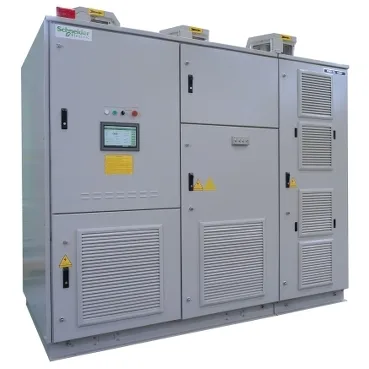
This is not a cabinet-mount drive — it ships as a floor-standing enclosure with separate air flows for the power section and control compartment. Dimensions vary by efficiency option: standard efficiency is 5170 mm wide × 1600 mm deep × 2670 mm high; high efficiency stretches to 5470 mm wide × 1700 mm deep at the same 2670 mm height. Plan the floor pad and overhead crane access accordingly — the cooling airflow alone is 23,100 m³/h on either variant. Forced convection cooling with an internal fan supply at 380 V AC, plus an external control supply at 220 V AC (3 kVA). An optional external fan supply at 380 V AC is available if the main bus is unreliable. Operating position is vertical ±10 degrees — no leaning the cabinet against a wall. Vibration resistance is 4.9 m/s² at 10-50 Hz, so the floor must be solid, not a mezzanine deck.
I/O complement and field wiring
Standard discrete inputs are 6, expandable to 10 with an optional card. Four analogue inputs and one analogue output (both software-configurable 0-20 mA / 4-20 mA) cover the typical speed reference and feedback loop. The analogue output impedance is 250 Ω — fine for a PLC analogue input module, but check the burden if you're driving a local meter. Main power connection uses bar-type terminals with M10 screws, clamping up to 6 × 40 mm² per phase, entry from bottom or top. Control wiring lands on separate terminals; electrical isolation between power and control is standard, so the 24 V loop stays clean even during a fault event.
Standards, environment, and lifecycle
CE marked, compliant with EN/IEC 60204-11, EN/IEC 60529, EN/IEC 61800-3 (EMC), EN/IEC 61800-4, and EN/IEC 61800-5-1. Pollution degree 2 per the safety standard, so the enclosure keeps out conductive dust. Operating altitude is 1000-2000 m with a 0.6 % current derating per 100 m above 1000 m — at 2000 m you lose about 6 % of the rated output current. Relative humidity range is 0-90 %, with an optional 95 % variant for tropical environments. Acoustic noise is 80 dB — that is loud enough to require hearing protection within a few meters during operation. The enclosure colour is grey RAL 7032, standard for industrial switchgear. Lifecycle status is current production, so no end-of-life panic on this order code; it is sourced through authorized channels against an RFQ.