What the 24-pulse rectifier buys you
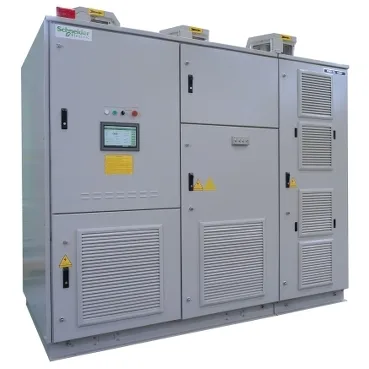
The ATV1200A44004242: The 24-pulse diode rectifier bridge on the input side cancels the 5th and 7th harmonics that a standard 6-pulse drive would inject back onto the line. For a 4400 kVA apparent power draw, that harmonic mitigation is the difference between passing IEEE 519 at the PCC and needing a separate active filter. The integrated EMC filter handles the conducted emissions side. The prospective line Isc rating of 31.5 kA for 150 ms tells you the drive can ride through a bolted fault on the incoming supply without the DC bus collapsing into an uncontrolled shoot-through — the rectifier diodes and the bus capacitors are sized for that fault energy.
Overload profile and motor matching
Two overload profiles are available: standard overload handles 1.2 In for 60 s and 1.5 In for 3 s; high overload handles 1.5 In for 60 s and 1.85 In for 3 s. The high-overload curve is what you need if the driven load (crusher, centrifuge, extruder) presents a breakaway torque peak that lasts longer than a few line cycles. The standard curve is sufficient for centrifugal pumps and fans where the torque demand ramps smoothly. The drive is listed for both synchronous and asynchronous motors, so the same unit can run an induction motor in V/Hz mode or a PM motor in closed-loop vector — the control architecture supports both rotor types without hardware changes.
Physical footprint and site prep
Forced convection cooling moves 70,000 m³/h of air at a noise level of 80 dB. That is loud enough to require hearing protection within the room — factor that into the room layout if operators work nearby.
The drive carries CE marking and is certified to EN/IEC 60204-11, EN/IEC 60529, EN/IEC 61800-3, EN/IEC 61800-4, and EN/IEC 61800-5-1. That covers electrical safety, EMC emissions/immunity, and functional safety integration. The dielectric strength is tested at 20 kV AC between earth and power terminals — that is the insulation coordination for a 3.3 kV-class drive. Pollution degree 2 per EN/IEC 61800-5-1 means the drive is rated for a dry, non-conductive environment — typical of a climate-controlled electrical room. If the installation site has conductive dust or condensation, the enclosure protection (IP rating per EN/IEC 60529) becomes the deciding factor.