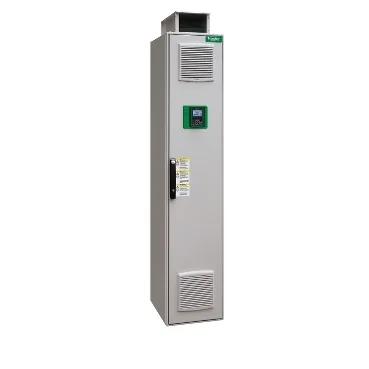
132 kW normal duty at 380–440 V
The ATV630C13N4F is a Schneider Electric Altivar Process variable speed drive rated for 132 kW normal duty and 110 kW heavy duty on a 380...440 V supply. It delivers 250 A continuous output at 2.5 kHz for normal duty, and 211 A at the same switching frequency for heavy duty — the derating between duty classes is about 15 %, which matters when the motor load profile is closer to constant torque than variable torque. The output frequency range is 0.1...500 Hz, covering both standard induction motors and higher-speed synchronous machines. Line current at 400 V is 210 A normal duty, 179 A heavy duty; at 380 V it draws 244 A normal, 207 A heavy — the voltage dependency means a weak grid or long feeder run will pull the input current higher than the 400 V nameplate suggests.
STO SIL 3 and integrated C3 EMC filter
Safe torque off (STO) is built in to SIL 3 per IEC 61800-5-2, which eliminates the need for an external safety relay on the power removal path in most guarding circuits. The integrated EMC filter meets category C3 with 150 m of motor cable — that covers the majority of industrial runs without an external output filter, though installations with sensitive equipment on the same bus may still need an input line reactor. Total harmonic current distortion (THDI) is below 48 % at full load per IEC 61000-3-12, which is the standard for equipment connected to the public low-voltage network above 16 A per phase. The drive also carries CE marking and complies with IEC 60204-1, IEC 61800-2, IEC 61800-3, and IEC 61800-5-1 — the full machinery directive stack for variable-speed drives in Europe.
Floor-standing with forced convection, 720 m³/h
This is a floor-standing unit (IP21 per IEC 61800-5-1 and IEC 60529), not a panel-mount or wall-mount drive. The forced-convection cooling moves 720 m³/h of air, so the installation space needs clear intake and exhaust paths — stacking enclosures or tight corners will recirculate hot air and trigger thermal derating. Operating altitude is 1000 m base with 1 % derating per 100 m above that, up to 4800 m. Ambient temperature range is -15 to 40 °C without derating, and up to 50 °C with a derating factor applied.
Communication slot architecture and PID control
Slot A accepts fieldbus option cards: Profibus DP V1, PROFINET, DeviceNet, Modbus TCP/EtherNet/IP, CANopen (daisy chain RJ45, SUB-D 9, or screw terminals), and Ethernet Powerlink. Slot A and slot B also accept digital/analog I/O extension modules and output relay extension modules. The base communication ports are Ethernet, Modbus serial, and Modbus TCP — so the drive ships network-ready for most plant-floor architectures without an option card. An adjustable PID regulator is built into the regulation loop, which means the drive can close a process loop (pressure, flow, level) directly without a separate controller. The 8 discrete inputs include two that are programmable as pulse inputs up to 30 kHz, useful for encoder or flowmeter feedback.