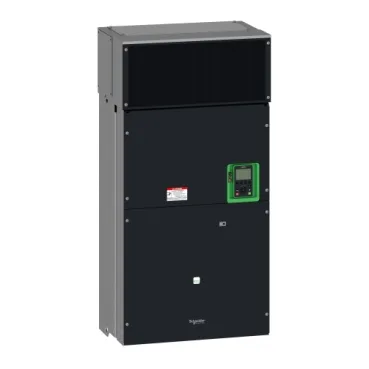
What the 481 A continuous output means for your motor load
The ATV630C25N4 is a 481 A continuous output drive in the Altivar Process ATV600 family, sized for 250 kW normal duty / 220 kW heavy duty on asynchronous or synchronous motors. That 481 A figure is at 2.5 kHz switching — if you push the carrier frequency higher, the output current derates, so the 481 A is the ceiling for a standard pump or fan application. The line current at 380 V normal duty pulls 451 A; at 480 V normal duty it's 366 A. That spread tells you the drive is current-limited, not voltage-limited — the motor kW rating shifts with the supply voltage.
Safety and compliance: STO SIL 3 and the standards stack
Built-in Safe Torque Off (STO) rated SIL 3 means this drive can serve in a safety circuit without an external safety relay for the torque removal function — it removes rotational energy from the motor shaft per IEC 61508 and ISO 13849-1. That simplifies the panel wiring for a guarding application. The drive carries CE marking and complies with UL 508C, IEC 61800-3 (environment 1 category C2 and environment 2 category C3), plus IEC 61000-3-12 for harmonic limits. The integrated EMC filter is rated for 50 m cable at category C3 — enough for most industrial installations without an external filter. That matters for the site electrical engineer coordinating the SCCR upstream.
Mounting, cooling, and physical integration
Wall-mount chassis, IP00 as shipped — you need the VW3A9113 kit to reach IP21. The drive moves 1260 m³/h of forced-convection cooling air, so the enclosure must have intake and exhaust vents sized for that volume. Operating position is vertical ±10°, which is standard for a wall-mount VFD. Vibration resistance is 1.5 mm peak-to-peak at 2-13 Hz and 1 gn at 13-200 Hz per IEC 60068-2-6; shock is 15 gn for 11 ms per IEC 60068-2-27. That's typical for a drive that goes on a machine frame, not just a control-room floor.
Fieldbus and I/O: what you can plug into Slot A
The drive has a Slot A for communication modules — Profibus DP V1, PROFINET, DeviceNet, Modbus TCP/EtherNet/IP, CANopen (daisy chain RJ45, SUB-D 9, or screw terminals), Ethernet Powerlink, and BACnet MS/TP. The base unit already has Modbus serial and Ethernet, so for a simple Modbus TCP line you don't need an option card. Eight discrete inputs, two of which (DI7, DI8) are programmable as pulse inputs up to 30 kHz. That's enough for a basic encoder feedback or flowmeter input without an extra card. There's also an adjustable PID regulator built in — set it for pressure or flow control and the drive closes the loop itself.
Quoted to order against the BOM quantity. No stock-holding claim; sourced per RFQ.