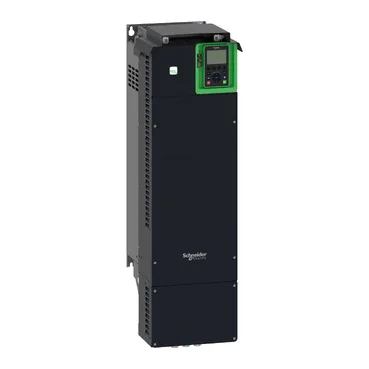
The ATV630D30M3US: Rated motor power of 30 kW normal duty / 22 kW heavy duty tells you the continuous thermal capability under standard overload profiles. The 123 A continuous output at 2.5 kHz switching frequency is the baseline — if you need to run a higher carrier frequency for quieter motor operation, derate per the datasheet's thermal curves. Safety function STO (Safe Torque Off) is rated SIL 3, which means a single drive can serve in a safety loop without an external contactor, saving panel space and wiring. Bring the safety signal directly to the drive's STO terminals. The integrated adjustable PID regulator suits process applications where you need closed-loop control of pressure, flow, or level without a separate controller.
Wall-mount design with IP21 / UL type 1 enclosure. Mount vertical within ±10° — manufacturers specify this orientation to maintain forced-convection airflow (295 m³/h at full fan speed). No built-in EMC filter, so plan for an external filter if the installation must meet conducted emissions limits (e.g., IEC 61800-3 environment 1 category C2). The drive accepts 200…240 V AC at 50/60 Hz ±5%. Slot A accepts optional communication modules: Profibus DP V1, PROFINET, DeviceNet, Modbus TCP/EtherNet/IP, CANopen, BACnet MS/TP, or Ethernet Powerlink. The drive ships with a built-in Modbus serial and Ethernet Modbus TCP port. I/O extension and relay output modules also fit slot A or a second slot B. Eight discrete inputs, two of which (DI7 and DI8) are programmable as 0…30 kHz pulse inputs. Power and control wiring guidance: the drive provides 24 V DC on the digital inputs (1 MΩ input impedance).
Closing note
This is the standard version ATV630 with no EMC filter, intended for OEMs or panel builders who add their own filter and want to avoid paying for one they don't use. If your BOM calls for an integrated filter, order the -F version instead. For a packing-line application, the built-in PID and the Modbus TCP port let you tweak speed profile recipes via the line controller — changeover in minutes if you've mapped the parameters to a recipe database.