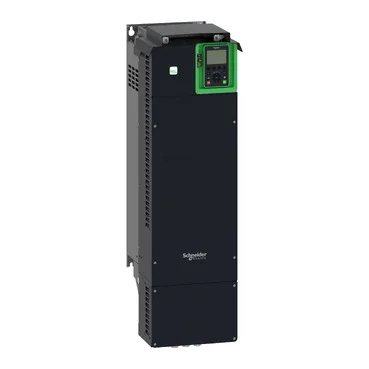
The ATV630D90N4 is a 90 kW normal-duty drive at 480 V, delivering 173 A continuous output at a 2.5 kHz switching frequency. For constant-torque loads like conveyors or extruders, the heavy-duty rating of 75 kW at 145 A is the ceiling you design to. The normal-duty 90 kW rating assumes variable-torque (pump/fan) profiles where the load drops with speed, so the thermal stress on the IGBTs stays lower. Line current at full load runs 156.2 A at 380 V and 135.8 A at 480 V in normal duty. That tells you the upstream contactor and fuse block need to be rated for at least 160 A continuous — and the cable sizing follows the 75 °C column of the NEC, not the 90 °C column, because the drive terminals are typically rated for 75 °C.
Safety and compliance — STO SIL 3 and the standards stack
Safe torque off (STO) integrated to SIL 3 per IEC 61508 means this drive can serve as the final safety element in a stop category 0 circuit without an external safety relay. The safety function is inside the drive — you wire the STO inputs to your safety PLC or light curtain, and the drive disables gate drive to the IGBTs within the fault reaction time. The drive carries UL 508C listing for the US and Canada, plus IEC 61800-3 for EMC. The integrated EMC filter is rated for 150 m of motor cable at category C3 — that covers most industrial runs up to 500 ft. If your cable run exceeds that, you add an external output filter before the motor terminals. The IP21 enclosure confirms indoor use only; if the panel sees washdown or dust, the drive needs a higher-rated enclosure around it.
Fieldbus and I/O — slot A communication modules
The drive has one option slot (slot A) that accepts a communication module. The list covers Profibus DP V1, PROFINET, DeviceNet, Modbus TCP/EtherNet/IP, CANopen (three connector variants), Ethernet Powerlink, and BACnet MS/TP. That means you can drop this drive into almost any existing fieldbus architecture without a gateway — just pick the module that matches your PLC network. There is also a slot A/slot B I/O extension module and an output relay extension module. The base drive already has 8 discrete inputs (DI7 and DI8 can be programmed as pulse inputs up to 30 kHz), plus analog I/O. For applications needing more than the onboard complement, the extension modules add terminals without a separate remote I/O block. The onboard communication ports include Ethernet, Modbus serial, and Modbus TCP. That gives you a fallback if the slot A module is not yet installed — you can commission the drive over Modbus serial using the standard Schneider programming tool.
Mounting, cooling, and environmental limits
Wall-mount only, vertical within ±10 degrees. The forced-convection cooling moves 295 m³/h of air — that is about 7800 CFM. The intake and exhaust need clear space around the heatsink fins; stacking drives directly above each other without a baffle will recirculate hot air and derate the upper drive. Operating altitude from 1000 m to 4800 m requires derating the output current by 1% per 100 m above 1000 m. At 2000 m (6560 ft), you lose 10% of the rated current — so the 173 A normal-duty figure drops to about 156 A. If your site is above 1000 m, size the drive one frame up or accept the derated output. Vibration resistance is 1.5 mm peak-to-peak from 2 to 13 Hz, then 1 gn from 13 to 200 Hz. Shock resistance is 15 gn for 11 ms. That is typical for industrial panel mounting on a machine base — not for direct mounting on a vibrating pump or compressor without isolation mounts.
Sourcing and lifecycle — active production, quoted to order
Sourced through independent distribution channels, quoted to order against your BOM quantity. If you are replacing an older Altivar 61 or 71 series drive, the ATV630 is the functional replacement but the parameter set and terminal layout differ; a commissioning download from the old drive will not load directly.