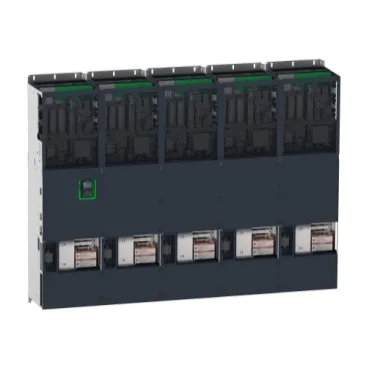
Dual-duty power rating and what it means for the load
The ATV6B0C80T4 carries two distinct power ratings: 800 kW (1100 hp) at 480 V for normal-duty applications and 630 kW (900 hp) for heavy-duty cycles. Line current follows the same split: 1049 A at 480 V normal duty, 862 A at 480 V heavy duty. The heavy-duty current is the figure to size the input conductors and upstream protection for a constant-torque conveyor or extruder application. Apparent power is 872 kVA at 480 V normal duty and 717 kVA at 480 V heavy duty. That kVA number drives the transformer and generator sizing if the drive is fed from an isolated supply rather than a utility grid.
Safety function and integrated EMC filter
That means the drive's power stage can be disabled by a safety circuit without a separate contactor — the STO function removes the rotational energy from the motor shaft at the drive output, meeting the requirements for a Category 3 / PL e safety system. The safety CPU on the control board monitors the STO request independently of the main processor. The integrated EMC filter meets IEC 61800-3 category C3 with a cable length allowance of 300 m. Category C3 means the drive is intended for installation in an industrial environment where the mains supply is not shared with residential buildings. The 300 m cable run covers most motor cable distances in a plant without an external output reactor, though the switching frequency setting affects the actual reach.
Communication slots and fieldbus options
Slot A accepts plug-in communication modules for Profibus DP V1, PROFINET, DeviceNet, Modbus TCP/EtherNet/IP, or CANopen (with RJ45, SUB-D 9, or screw terminal variants). The same slot also accepts digital/analog I/O extension and output relay extension modules. That means the drive can be ordered with the fieldbus interface already fitted, or the module can be swapped in the field without removing the drive from the cabinet. The base unit includes a 2-wire RS 485 Modbus serial port running RTU protocol at 4.8 to 38.4 kbit/s, plus a dual-port Ethernet IP/Modbus TCP interface at 10/100 Mbit/s with auto-negotiation. The Ethernet ports support daisy-chain topology, which saves a switch port in a multi-drive line. Total harmonic current distortion (THDI) is below 5% at full load per IEEE 519. That eliminates the need for a separate line reactor or active front end in most plant distribution systems where the utility requires THDI under 8% at the point of common coupling.
Cabinet integration and environmental limits
The drive is rated UL Type 1 and UL Type 12 when integrated into a cabinet per UL 61800-5-1. Type 12 means the enclosure protects against falling dirt and circulating dust — typical for a drive mounted inside a ventilated panel in a non-washdown area. The cabinet mount format means the power module and control unit are delivered as separate assemblies that bolt into the panel; the kit includes the mechanical mounting kit, power connection set, and fuse set. Operating altitude is 1000 m without derating; above that, current must be derated up to 4800 m. For a drive installed at 2000 m, the continuous output current drops by roughly 10% — factor that into the motor selection if the installation is at elevation. Switching frequency is adjustable from 2 to 8 kHz with a derating factor applied above 2.5 kHz. Running at 8 kHz quiets the motor whine but reduces the continuous output current by about 20% — the trade-off matters for an application where audible noise is a concern but the load is already near the drive's heavy-duty current limit.