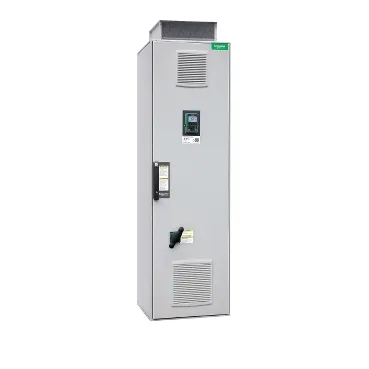
The ATV980C13Q4X1 is a regenerative variable speed drive from the Altivar Process ATV900 family, built for asynchronous and synchronous motors. It's the regenerative system variant — meaning it can return energy to the line rather than dumping it as heat across a braking resistor. That's the main differentiator from a standard ATV900 drive: you get the energy-recovery benefit, which matters on applications with overhauling loads like conveyors on a decline, centrifuges, or test stands. Rated supply voltage is 380...415 V at 50/60 Hz, three-phase. The power range is stated as 132 to 110 kW — that's the motor power it can handle, with the regenerative capability baked in. It ships in a floor-standing compact enclosure (IP23), light grey RAL 7035, with forced convection cooling.
What comes in the box and how it mounts
The drive arrives as a complete package: the Spacial SF enclosure with a graphical operating panel in the door, the frequency inverter, main switch, line choke, and terminal blocks for both main supply and motor connections. That's a pre-integrated assembly — you run your incoming power and motor cables to the terminals, not a bare chassis drive you build into a panel. Mounting position is vertical, within ±10 degrees. Cooling is forced convection, so ensure clearance around the enclosure for airflow. The operating temperature range is 0 to 40 °C without derating, with derating required from 40 to 50 °C. Below 0 °C, operation is possible with the optional enclosure heating. Storage temperature spans -25 to 70 °C.
Standards, EMC, and environmental ruggedness
This drive carries CE marking and complies with IEC 61800-2 (adjustable speed drives), IEC 61800-5-1 (safety requirements), IEC 61800-3 (EMC), and IEC 60204-1 (safety of machinery). Pollution degree 2 per IEC 61800-5-1, overvoltage category III. That's the standard spec for industrial power distribution — it expects a clean, dry environment with non-conductive pollution. Total harmonic distortion of input current (THDI) is below 5% at full load, conforming to IEEE 519. That's a strong number — it means the drive's input section is clean enough to avoid nuisance tripping of upstream breakers or overheating transformers in most plants. The EMC immunity levels are specified: electrostatic discharge level 3, radiated RF level 3, fast transient level 4, surge level 3, and conducted RF level 3 per the respective IEC 61000-4-x standards. Environmental classification covers chemical pollution resistance class 3C3, dust pollution resistance class 3S3, and humidity resistance class 3K3 per IEC 60721-3-3. Relative humidity 5 to 95% without condensation. Vibration resistance is 1.5 mm peak-to-peak at 3 to 20 Hz and 0.6 gn at 10 to 200 Hz, meeting class 3M3. Shock resistance is 4 gn for 11 ms per IEC 60068-2-27, class 3M2.
Altitude derating and communications
Standard operation is up to 1000 m without derating. Above that, derate 1% per 100 m up to 2000 m, and continue derating at the same rate up to 3800 m for TT, TN, and IT earthing systems. Extended operation to 4800 m is possible for TT and TN systems with continued derating. If your installation is above 1000 m, factor that into the sizing. Communication ports support EtherNet/IP, Modbus serial, and Modbus TCP. That covers most industrial networks without needing an option card — it talks to a PLC directly over Ethernet or serial. The graphical operator panel in the door gives local control and monitoring.
This is a regenerative drive — it's a specific variant within the ATV900 family. A standard ATV900 drive won't recover energy to the line.