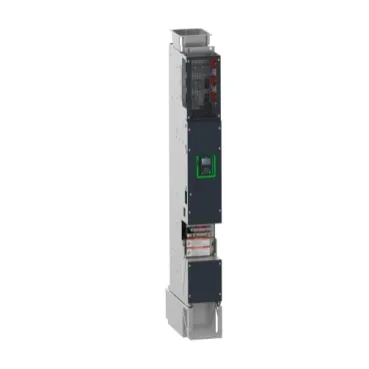
Supply rails — three distinct feeds
The ATV9A0C11Q6: Control power is split three ways: digital inputs need a 24 V DC external supply (19–30 V), the reference pot gets its own 10.5 V DC ±5 % from the drive, and the STO circuit runs on a separate 24 V DC rail (21–27 V). That means your panel layout needs three branches — don't daisy-chain the STO feed off the digital input supply. Insulation resistance is 1 MΩ at 500 V DC for 1 min; keep that in mind for megger testing after installation.
Cabinet-mount only. Forced convection cooling. IP00 as shipped, but it's built for IP21 or IP54 cabinet integration. Vibration: 1.5 mm peak-to-peak at 2–13 Hz, 0.5 gn at 13–200 Hz. Shock 4 gn, 11 ms. Pollution degree 2 per IEC 61800-5-1. Operating altitude to 2000 m with derating above 1000 m. Relative humidity 5–95 % without condensation. Noise level 69 dB — plan ear protection if you're benching it open.
Communication and options
Three slot architecture for option cards: Slot A takes Profibus DP V1, PROFINET, DeviceNet, EtherCAT, or CANopen (RJ45, SUB-D 9, or screw). Slots A/B/C accept digital/analog I/O expansion or output relay extension. Slot B can also take a 5/12 V digital encoder interface, analog encoder interface, or resolver interface. Built-in Modbus serial (2-wire RS-485, RTU, 1–247 addresses) and Ethernet IP/Modbus TCP (10/100 Mbit/s, half/full duplex). Data format 8 bits, parity configurable.