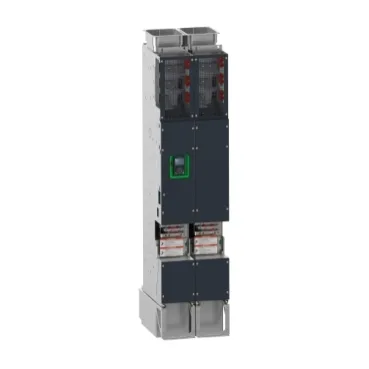
The ATV9A0C31N6: Line current at 500 V normal duty pulls 303 A; heavy duty pulls 225 A. That's the figure for cable sizing and upstream breaker coordination. Prospective line short-circuit rating is 50 kA — the drive can ride through a stiff grid. Switching frequency is adjustable from 2 to 4.9 kHz; expect derating above 2 kHz if you're pushing the full output current. For a nacelle environment, the vibration rating is the one to trust: 1.5 mm peak-to-peak at 2...13 Hz, then 0.5 gn up to 200 Hz. Shock survival is 4 gn for 11 ms. That's enough to handle main bearing rumble and blade-pitch transient events. The integrated EMC filter meets IEC 61800-3 category C3 for 300 m cables — no external filter needed for most industrial installations. STO is SIL 3, which simplifies safety-loop design for the pitch system or brake control.
Communication and fieldbus options
The base drive includes a Modbus serial port (2-wire RS-485, RTU, up to 38.4 kbps) and an Ethernet port running Modbus TCP/IP or Ethernet/IP at 10/100 Mbps. For Profibus, PROFINET, DeviceNet, EtherCAT, or CANopen, you add a communication module in Slot A. Slot A also takes digital/analog I/O or relay extension modules. Slot B is for encoder feedback — either 5/12 V digital, analog, or resolver. That gives you flexibility for closed-loop speed or position control on the pitch axis.
Marked CE. Designed to IEC 61800-3 (EMC), IEC 61800-5-1 (safety), IEC 61000-3-12 (harmonics), IEC 60721-3 (environmental), and functional safety standards IEC 61508 and IEC 13849-1. Pollution degree 2 per IEC 61800-5-1, which covers normal industrial atmospheres. Relative humidity 5...95% non-condensing. The drive includes thermal protection for both motor and drive, plus phase loss, overvoltage, undervoltage, overspeed, and short-circuit detection. For the compliance documentation pack, expect a CE declaration and the certificate package covering the listed IEC standards—ask your sales contact for the full set if you need them for a project submittal.