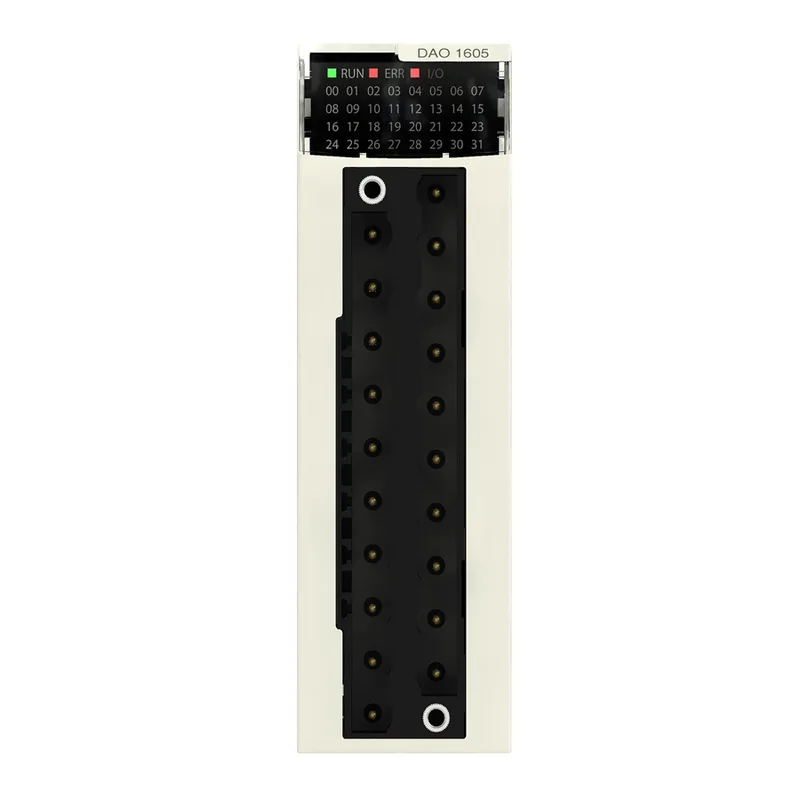
What this module is, and what it needs
The BMXDAO1605: The module lists a 20 A inrush and requires one external fast-blow fuse. That's not optional – it's listed as the protection type. Without that fuse, a shorted triac will take out the module's internal traces.
Fitting it into the panel
Operating temperature 0-60 °C, storage -40-85 °C. If your panel gets above 60 °C near the rack, you'll need forced airflow or derating. The 5-95% humidity at 55 °C (non-condensing) is typical for industrial, but watch condensation if the panel is outdoors.
Live with it: field service notes
Diagnostic LEDs are straightforward: a green RUN, a red ERR, a red I/O for module-level faults, and one green LED per channel for channel diagnostics. That makes fault isolation quick without a software scan – channel LED out means that output isn't on. Off-state leakage is 1.5 mA at 120 V AC, up to 3 mA at 240 V AC. If your load is a contactor coil or a solid-state relay that needs near-zero current when off, you'll need a bleeder resistor or an interposing relay. Triacs leak – that's the physics. Response time for deactivation is under 1.011 ms (resistive load). For inductive loads, you'll see a slower turn-off due to the triac's turn-off characteristics. The datasheet doesn't publish that data, but plan for on the order of half a cycle. The module draws 79 mA at 3.3 V DC from the rack backplane. That's modest; you won't run out of backplane power with this in a typical X80 setup.
Sourcing posture
Compliance documentation includes 2014/35/EU Low Voltage Directive and 2014/30/EU EMC Directive. Those cover CE marking for the European market. No other certifications (UL, CSA, RCM) are listed in the specs, but the module carries the Modicon X80 pedigree – typically used in panels that go through full system certification.