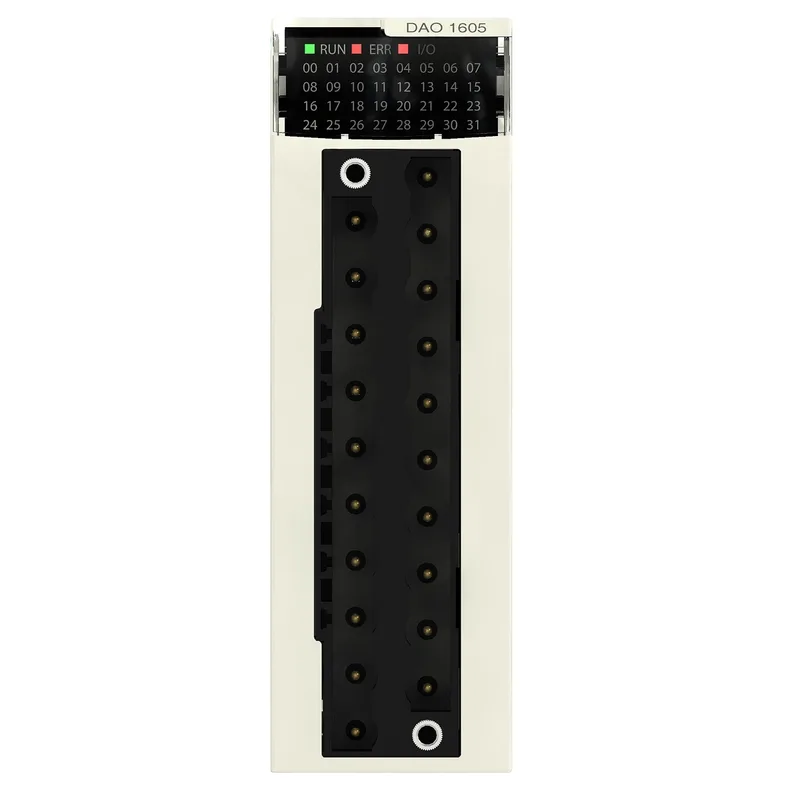
The BMXDAO1605H: Per-channel current is 0.6 A at 60 °C, but drops to 0.24 A at 70 °C. The module max is 4.8 A at 60 °C (1.92 A at 70 °C). If your panel ambient runs near 70 °C, derate early — that's on the critical path for output budget. It carries conformal coating and gas, dust, sand, salt, and mold resistance — rated for severe environments (Gx, 3C4, 3S4, etc.). That means it lands before the window in places where standard modules wouldn't survive a season.
Against the BMXDDO1602H (16-channel solid-state 24 V DC): this module is AC only, with triac outputs. The BMXDDO1602H has electronic short-circuit protection and a 1.5 A per channel limit, but runs on 24 V DC. If the BOM calls for AC loads (valves, contactors, indicators), the BMXDAO1605H fits; if it's a 24 V DC control panel, stick with the BMXDDO1602H. Against the BMXDRA0804T (8-channel relay, 100–150 V DC / 100–240 V AC): half the channel count, mechanical contacts, slower response (~10 ms). The BMXDAO1605H gives you twice the density with solid-state switching at 1 ms. Use the relay module if you need galvanic isolation per point or switch higher inrush; use the triac module for fast, frequent AC switching.
Lifecycle and sourcing — what you need for the BOM freeze
Directives on file: 2014/35/EU (Low Voltage) and 2014/30/EU (EMC). No specific RoHS, REACH, or UL statements in this record, but the conformal coating and severe-environment test set (gas, dust, salt) suggest it was designed for IEC 60068-2-type qualification. If a compliance pack is needed, flag it on the order. Requires an external fast-blow fuse per group; the module itself doesn't carry fuses onboard. Inrush peaks at 20 A, so size the fuse and wiring accordingly. That's a sourcing detail to confirm before the panel build window closes.
The BMXDAO1605H fits any Modicon X80 rack slot. Spring-cage terminals on the front (not included in spec, but typical for X80 discrete modules — verify with the product manual if wiring detail is critical). IP20, so it belongs in an enclosure. Leakage current: 1.5 mA at 120 V AC, 3 mA at 240 V AC. If you're driving small PLC inputs or high-impedance loads, that leakage may hold the circuit on — plan a bleed resistor or verify load impedance above the leakage threshold. Response time: ≤1.011 ms resistive deactivation (AC zero-cross turn-off). For fast-acting solenoids or contactors, that's typically fine. If you need sub-ms switching, note the triac turns off at current zero, so there's a natural half-cycle delay.